The three principal sources of law legislation, precedent, and custom each have distinctive strengths and weaknesses. No single source is sufficient alone; modern legal systems combine all three in a hierarchy. The comparative analysis reveals that legislation excels in comprehensiveness and reform, precedent excels in practical wisdom and gap-filling, and custom excels in organic social rootedness.
Three Juristic Perspectives (BMA Framework)
| Jurist | Position | Core Argument |
|---|---|---|
| Bentham | Pro-legislation | Legislation is superior because it is democratic, accessible, prospective, and systematic. Precedent is "Dog Law": like training dogs by hitting them after the act, citizens discover legal obligations only AFTER being punished for violating an unwritten rule |
| Maine | Evolutionary | Legal systems progress from custom (primitive) to precedent (intermediate) to legislation (advanced). Each stage represents growing sophistication. Custom is natural; legislation is deliberate |
| Allen | Synthetic | No single source is inherently superior. Each has distinctive strengths. Mature legal systems need ALL THREE: legislation for reform, precedent for detail, custom for legitimacy |
Bentham's "Dog Law" critique: Precedent operates retrospectively. A person acts, a court declares it unlawful, and the person suffers. Like punishing a dog after the fact, the citizen had no way to know the rule before violating it. Legislation avoids this by declaring rules IN ADVANCE (prospectively). This is Bentham's strongest argument for legislative supremacy over judge-made law.
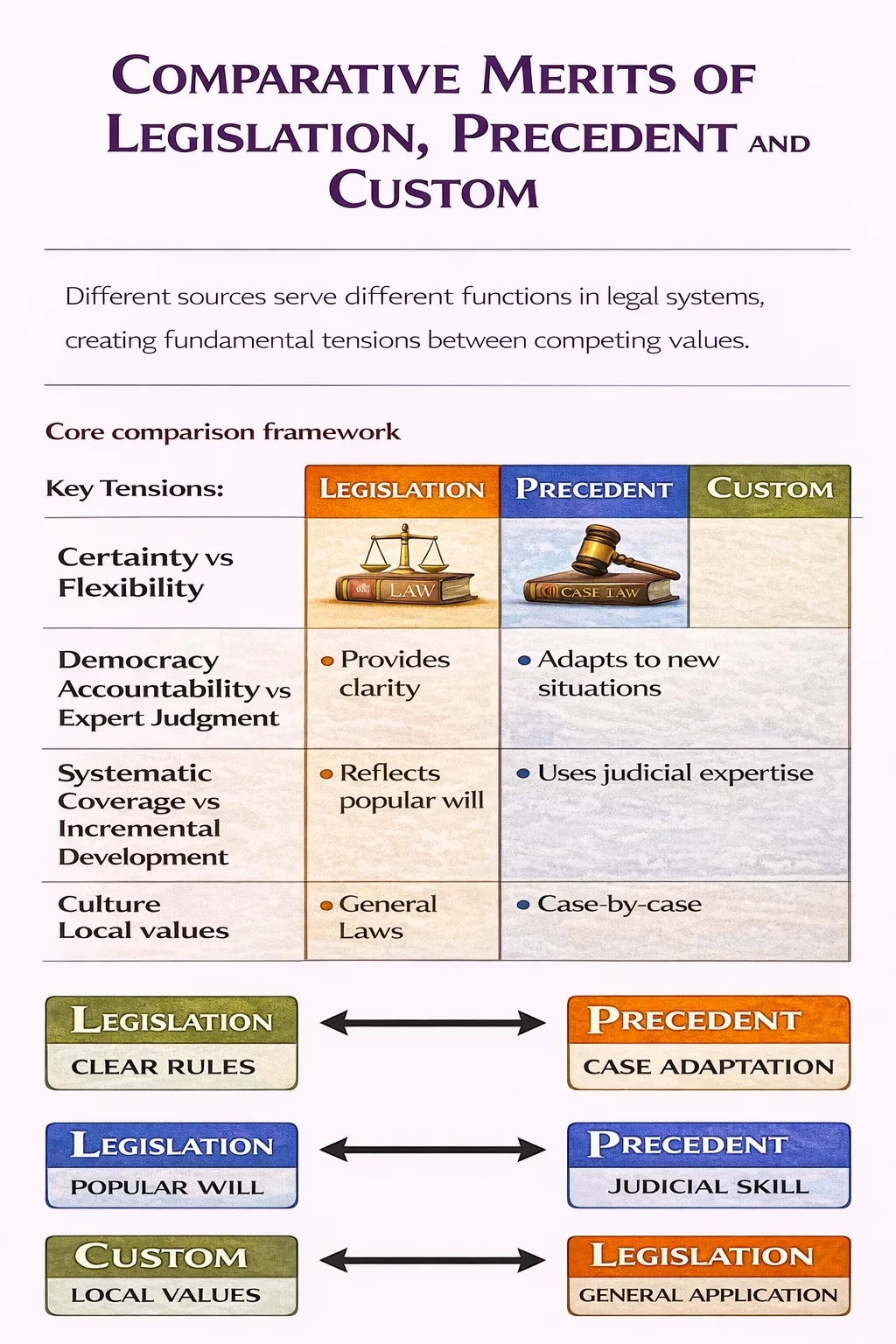
Legal Framework
| Source | Strength | Weakness |
|---|---|---|
| Legislation | Comprehensive, democratic, prospective | Rigid, may not reflect social reality |
| Precedent | Practical, fills gaps, equality (like cases alike) | Retrospective, volume creates complexity |
| Custom | Organic, socially rooted, accepted | Uncertain, slow to develop, may be unjust |
Comparative Analysis
| Criterion | Legislation | Precedent | Custom |
|---|---|---|---|
| Certainty | HIGH written, published, accessible | MODERATE ratio may be debatable | LOW unwritten, proved by evidence |
| Flexibility | LOW requires amendment process | MODERATE evolves case-by-case | LOW changes very slowly |
| Democracy | HIGH elected representatives | LOW unelected judges | MODERATE community consensus |
| Speed of creation | FAST can be enacted in days (ordinance) | SLOW must wait for case to arise | VERY SLOW evolves over generations |
| Reform potential | HIGH can transform society overnight | MODERATE incremental change | LOW conservative, preserves status quo |
| Practical wisdom | LOW often theoretical, untested | HIGH based on real disputes | HIGH based on lived experience |
| Retrospective? | Usually NO (prospective) | Usually YES (declares what law "was") | Neither (always existed) |
| Comprehensiveness | HIGH covers entire subject | LOW one point per case | LOW specific practices only |
| Social rootedness | VARIABLE may be imposed top-down | MODERATE responds to real disputes | HIGH grows from community life |
| Abolition of injustice | EASY repeal the unjust law | DIFFICULT overruling takes time | VERY DIFFICULT custom resists change |
Merits of Legislation Over Other Sources
| Merit | Explanation |
|---|---|
| Abrogative power | Can expressly repeal old law (precedent can only be overruled; custom can only be declared invalid) |
| Prospective operation | Applies to future conduct (citizens can plan); precedent is often retrospective |
| Comprehensive coverage | Can address an entire subject exhaustively; precedent addresses one issue at a time |
| Democratic legitimacy | Enacted by elected representatives with public mandate |
| Speed of reform | Can respond immediately to social crises (ordinances, emergency legislation) |
| Clarity of expression | Written in formal language; easier to identify than extracting ratio from judgments |
Merits of Precedent Over Other Sources
| Merit | Explanation |
|---|---|
| Practical basis | Arises from REAL disputes (not hypothetical situations legislators imagine) |
| Fills legislative gaps | Where statute is silent, precedent provides rules |
| Detailed application | Shows exactly how abstract principles apply to specific facts |
| Equality | Stare decisis ensures like cases are treated alike |
| Incremental wisdom | Develops gradually avoids drastic changes that legislation might impose |
| Responsive | Courts can immediately address novel situations without waiting for Parliament |
Merits of Custom Over Other Sources
| Merit | Explanation |
|---|---|
| Social acceptance | Already followed voluntarily no enforcement problem |
| Organic development | Reflects actual living patterns of communities |
| Local suitability | Adapts to specific local conditions (national legislation may not) |
| Historical depth | Carries accumulated wisdom of generations |
| Stability | Resistant to sudden political changes (legislation can change with government) |
| Cultural identity | Preserves community distinctiveness and tradition |
Illustrations
-
When legislation is superior (reform against custom): Custom: Hindu daughters excluded from inheritance (centuries-old practice). Precedent: courts recognised this custom as valid. NEITHER custom nor precedent could reform this injustice both PRESERVED it. Only LEGISLATION could override: Hindu Succession (Amendment) Act, 2005 gave daughters equal coparcenary rights. Parliament imposed reform that society and courts would not generate organically. This is legislation's unique abrogative power it can kill unjust custom and overrule harmful precedent.
-
When precedent is superior (novel situations): No statute addressed sexual harassment at the workplace before 2013. In Vishaka (1997), the Supreme Court created detailed guidelines (original precedent). Parliament was SILENT for 16 years (1997-2013). During this gap, women's protection depended entirely on judicial precedent. Legislation eventually arrived (POSH Act, 2013) but for 16 years, only precedent governed. In novel situations where Parliament hasn't acted, precedent is the ONLY source that can respond immediately.
-
When custom is superior (local knowledge): National water legislation may allocate river water based on state boundaries. But in a village where 5 families have shared a well for 200 years under a rotation custom (3 hours each, Monday through Friday), the national law is IRRELEVANT to daily practice. The custom reflects local conditions (well capacity, number of families, seasonal variation) that no distant legislature could have anticipated. For purely local matters, custom is often MORE effective than legislation because it reflects ground-level reality.
-
The synthesis (Indian system uses all three): Indian law on marriage uses ALL THREE sources simultaneously: (a) LEGISLATION: Hindu Marriage Act defines valid marriage conditions (age, prohibited degrees, monogamy). (b) CUSTOM: Marriage ceremonies performed per community custom are valid (S.7 HMA "rites and ceremonies" per custom). (c) PRECEDENT: Courts interpret disputed issues (Is a second marriage void or voidable? Bhaurao v. State of Maharashtra precedent clarifies). No single source could adequately govern marriage each contributes what it does best.
Recall Check
- In what respect is legislation superior to both precedent and custom?
- Why is precedent considered more "practical" than legislation?
- When is custom superior to legislation as a source of law?
Distinctions
| Aspect | Legislation | Precedent | Custom |
|---|---|---|---|
| Creator | Legislature | Courts | Community |
| Form | Written, enacted | Written (judgments) but ratio must be extracted | Unwritten (proved by evidence) |
| Temporal | Prospective | Usually retrospective | Neither (always existed) |
| Change | By amendment/repeal | By overruling/distinguishing | By gradual social evolution |
| Democratic? | Yes (elected) | No (appointed judges) | Partially (community consensus) |
| Speed | Fast | Slow (case must arise) | Very slow |
| Certainty | High | Moderate | Low |
| Reform power | Highest (can abrogate) | Moderate (incremental) | Lowest (preserves status quo) |
| Gap-filling | Cannot anticipate all situations | Fills gaps left by legislation | Fills gaps in remote/local matters |
Flashcards
What is the chief advantage of legislation over precedent and custom?
Abrogative power legislation can expressly repeal old law, override custom, and reverse precedent. Neither precedent nor custom can repeal legislation.
What is the chief advantage of precedent over legislation?
Practical wisdom precedent arises from real disputes and shows how abstract principles apply to concrete facts. Legislation is often theoretical until tested in court.
What is the chief advantage of custom over legislation?
Social acceptance custom is already voluntarily followed by the community, so compliance is natural. Legislation may face resistance if imposed against prevailing practice.
Why does legislation usually operate prospectively while precedent operates retrospectively?
Legislation applies to FUTURE conduct (citizens can plan). Precedent declares what the law "always was" so it applies to the dispute that gave rise to it (which occurred BEFORE the decision).
Can legislation alone govern a modern legal system?
No legislation cannot anticipate every situation. Gaps exist. Courts fill these gaps through precedent. Custom governs where both statute and precedent are silent.
What is the weakness common to both custom and precedent?
Uncertainty custom is unwritten (must be proved); precedent requires extracting ratio from complex judgments (debatable). Legislation's written form provides greater certainty.
Exam Scenario
"Legislation is the most powerful but not always the most effective source of law." Evaluate the relative strengths and weaknesses of legislation, precedent, and custom.
Legislation's power: (1) Abrogative only source that can expressly REPEAL existing law. (2) Comprehensive covers entire subjects. (3) Prospective no unfairness of retrospective application. (4) Democratic reflects majority will through elected representatives. (5) Speed Parliament can respond to crises within days (ordinance power under Art.123).
Legislation's limitations: (1) Cannot anticipate ALL situations novel disputes arise that statute doesn't cover (needed Vishaka to address sexual harassment before POSH Act). (2) Gap between law-in-books and law-in-action a statute prohibiting dowry (1961) hasn't eliminated dowry (2026). Legislation doesn't automatically change behaviour. (3) May be out of touch legislators in Delhi may not understand tribal customs in Nagaland or water-sharing in Tamil Nadu villages. (4) Rigidity amendment requires full parliamentary process (time-consuming).
When precedent is more effective: Where the question is NOVEL and requires immediate resolution; where the issue is too SPECIFIC for general legislation; where INCREMENTAL development is preferable to sudden change (privacy law developed through Govind (1975) → PUCL (1997) → Puttaswamy (2017) each case expanding gradually rather than one comprehensive statute).
When custom is more effective: Where legislation is ABSENT or INAPPROPRIATE (tribal communities with unique governance); where COMPLIANCE is the goal (people follow their own customs voluntarily enforcement is unnecessary); where LOCAL CONDITIONS make national legislation inapplicable.
Conclusion: Legislation is the most POWERFUL (highest in hierarchy, can override all others) but not always the most EFFECTIVE (power to enact ≠ power to change behaviour). Precedent is most effective for novel and specific situations. Custom is most effective for localised and community-specific governance. The Indian system correctly employs all three in a hierarchy each contributing where it is strongest, with legislation holding ultimate authority but not monopolising law-making.