The Analytical School (also called the Positivist or Imperative School) studies law AS IT IS not as it ought to be. It analyses the structure, concepts, and logical relationships within an existing legal system without evaluating its moral worth. Law is treated as a fact to be dissected, not a value to be judged.
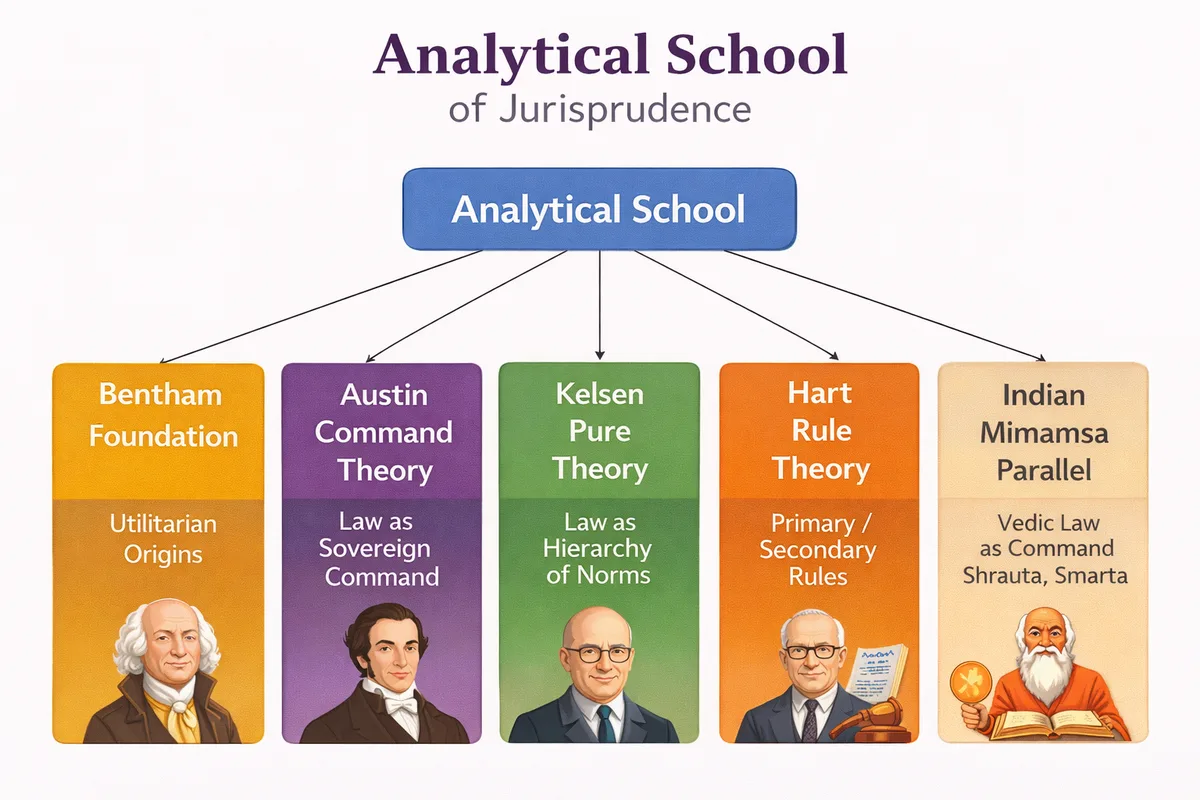
Legal Framework
| Element | Content |
|---|---|
| Also called | Positivist School, Imperative School, English School |
| Central claim | Law is the COMMAND of the sovereign backed by sanction |
| Method | Logical analysis of legal concepts (right, duty, sovereignty, sanction) |
| Separates | Law from morality ("law as it is" vs. "law as it ought to be") |
| Founders | Jeremy Bentham (1748-1832), John Austin (1790-1859) |
| Later positivists | H.L.A. Hart, Hans Kelsen |
Jeremy Bentham (1748-1832)
| Aspect | Content |
|---|---|
| Title | Father of modern positivism; "the great reformer" |
| Key work | An Introduction to the Principles of Morals and Legislation (1789) |
| Core idea | Law should be judged by UTILITY "greatest happiness of the greatest number" |
| On existing law | Must be ANALYSED (expository jurisprudence: what law IS) |
| On ideal law | Must be REFORMED (censorial jurisprudence: what law OUGHT to be) |
| Codification | Advocated complete codification of all law into accessible codes |
| On natural law | Rejected "natural rights are nonsense upon stilts" |
| On common law | Criticized as "judge-made law" undemocratic, uncertain, retrospective |
John Austin (1790-1859)
| Aspect | Content |
|---|---|
| Title | Father of English Jurisprudence |
| Key work | The Province of Jurisprudence Determined (1832) |
| Core idea | Law = COMMAND of the sovereign backed by SANCTION |
| Method | Strictly analytical separate law from morality |
Austin's Command Theory
Law is:
- A command (expression of wish that another shall act/forbear)
- Issued by a sovereign (politically superior person/body)
- Backed by a sanction (evil threatened for disobedience)
- Imposing a duty (obligation to obey)
| Element | Definition |
|---|---|
| Command | Expression of desire by a superior that an inferior SHALL do or abstain |
| Sovereign | Determinate human superior, habitually obeyed by the bulk of society, who habitually obeys no one |
| Sanction | Evil (punishment) inflicted if the command is disobeyed |
| Duty | Obligation created by the command; liability to the sanction |
Austin's Classification
| Category | Status |
|---|---|
| Positive law (commands of sovereign) | TRUE LAW subject of jurisprudence |
| Positive morality (social rules not from sovereign) | NOT law properly so called |
| Divine law (God's commands) | NOT subject of jurisprudence (belongs to theology) |
| Laws of nature (scientific laws) | NOT law at all (metaphorical use of "law") |
Why: Austin's separation thesis (law ≠ morality) was revolutionary. Before Austin, natural law theorists insisted that an "unjust law is no law" (lex injusta non est lex). Austin said: "The EXISTENCE of law is one thing; its MERIT or DEMERIT is another." A law may be unjust AND still be valid law. This cleared the ground for studying law scientifically without moral prejudice.
H.L.A. Hart (1907-1992)
Hart refined positivism by addressing Austin's weaknesses:
| Austin's Problem | Hart's Solution |
|---|---|
| Sovereign identified as person habitually obeyed | Rule of Recognition (social rule identifying valid law) |
| All law = commands (doesn't explain power-conferring rules like Wills Act) | Primary rules (duty-imposing) + Secondary rules (power-conferring) |
| Sanction essential to law | Nullity is a consequence, not a "sanction" (invalid will = no evil inflicted) |
| Cannot explain constitutional law (who commands the sovereign?) | Ultimate rule of recognition accepted by officials as standard |
Hart's Two Types of Rules
| Type | Function | Example |
|---|---|---|
| Primary rules | Impose duties (do/don't do) | "Thou shalt not kill" criminal law, tort law |
| Secondary rules | Confer powers (how to create, change, adjudicate primary rules) | Rule of Recognition (what counts as law); Rule of Change (Parliament can amend); Rule of Adjudication (courts can decide) |
Internal and External Points of View
Hart distinguished two ways of relating to rules:
| Perspective | Description | Example |
|---|---|---|
| Internal | Participants who ACCEPT rules as binding standards; feel obligated | A judge who applies the Constitution because she believes she ought to |
| External | Observers who describe behaviour without accepting rules | A sociologist studying how courts operate |
Understanding law requires both: the internal view explains WHY officials follow rules (not just habit but felt obligation); the external view enables scientific study of legal systems.
Hans Kelsen (1881-1973)
| Aspect | Content |
|---|---|
| Title | Father of the "Pure Theory of Law" |
| Key work | Pure Theory of Law (1934, revised 1960) |
| Core idea | Legal science must be purified of all sociology, psychology, ethics, and politics |
| Method | Study the VALIDITY of norms, not their moral content or social effects |
Kelsen's Pure Theory
Kelsen asked: What makes a legal norm VALID? Austin said: sovereign command. But that's sociological (who is obeyed). Kelsen wanted a purely LEGAL answer.
His insight: norms exist in a hierarchy. Each norm derives validity from a higher norm that authorises its creation:
| Level | Indian Example |
|---|---|
| Grundnorm (Basic Norm) | "The Constitution ought to be obeyed" (presupposed) |
| Constitution | Constitution of India, 1950 |
| Statutes | Indian Penal Code, enacted under Art. 245-246 |
| Subordinate legislation | Rules under the Factories Act (delegated legislation) |
| Individual decisions | Court judgments, administrative orders |
Each level validates the one below: a court judgment is valid because CPC authorises it; CPC is valid because Parliament enacted it under Art. 245; Art. 245 is valid because the Constitution authorises it; and the Constitution is valid because of the Grundnorm.
The Grundnorm
The Grundnorm ("basic norm") is NOT a positive legal rule; no one enacted it. It is a logical presupposition that makes the entire legal system possible. It says: "The historically first constitution ought to be obeyed." Without this presupposition, no legal norm can claim validity.
| Feature | Content |
|---|---|
| Nature | Hypothetical, not enacted; a logical condition for legal thinking |
| Content | "The Constitution ought to be obeyed" |
| Can it be proved? | No: it is presupposed, not validated by anything above it |
| What changes it? | Revolution: a successful revolution creates a new Grundnorm |
| Different from Rule of Recognition | Kelsen's is theoretical/logical; Hart's is empirical/social |
Indian Application of Kelsen
The basic structure doctrine (Kesavananda Bharati, 1973) can be understood through Kelsen: if Parliament's amendment power (Art. 368) derives from the Constitution, then amendments cannot destroy the Constitution itself: that would saw off the branch the amendment power sits on. The Grundnorm would be undermined. Some features are therefore logically unamendable.
Criticisms of Kelsen
| Criticism | Content |
|---|---|
| Circular | The Grundnorm explains validity but its own validity cannot be explained |
| Too formal | Ignores law's connection to social values and political choices |
| Cannot explain revolution | How do legal systems change through extra-legal means? A new Grundnorm simply "appears", no legal explanation possible |
| Emptied of content | By purifying law of all sociology and ethics, nothing meaningful is left to study |
The Hart-Fuller Debate (1958)
This debate crystallises the positivist vs natural law divide:
| Position | Hart (Positivist) | Fuller (Natural Law) |
|---|---|---|
| Nazi law was... | Legally valid (properly enacted) though morally evil | Not genuinely "law": violated law's inner morality |
| Valid law requires... | Proper enactment by recognised authority | Conformity to procedural moral standards (generality, publicity, non-retroactivity, clarity) |
| Immoral law... | Is still law; condemn it morally but accept its legal status | Fails so fundamentally that it loses the character of law |
Indian relevance: The basic structure doctrine reflects this debate. Parliament can amend the Constitution (Hart's rules of change), but cannot destroy its essential features (Fuller's insight that law has an inherent morality that cannot be legislated away).
Criticisms of the Analytical School
| Criticism | Source | Content |
|---|---|---|
| Ignores morality | Natural law theorists | Law without moral content is tyranny dressed up as legal order |
| Command theory too narrow | Hart, Kelsen | Power-conferring rules (Wills Act, Companies Act) are not "commands" no one is "commanded" to make a will |
| Sovereign unrealistic | Pluralists (Laski) | No single sovereign in federal systems (India: Centre + State + Constitution) |
| Ignores social context | Sociological school | Studying law without society is studying anatomy without life |
| Cannot explain international law | Critics | No world sovereign, yet international law exists |
| Cannot explain custom | Historical school | Custom becomes law WITHOUT sovereign command |
| Habit vs. obligation | Hart | Austin confused "habit of obedience" (merely doing X regularly) with "obligation" (believing one OUGHT to do X) |
Illustrations
-
Austin's command theory in action (and its limits): Parliament passes the Motor Vehicles Act: "Every person driving a motor vehicle shall possess a valid licence. Penalty: Rs.5,000 fine." Under Austin: Parliament (sovereign) issues a COMMAND (must have licence), backed by SANCTION (Rs.5,000 fine), creating a DUTY (obligation to get licence). This fits perfectly.
NOW try: the Indian Succession Act says "Any person of sound mind may make a will." Is this a "command"? Who is being COMMANDED? If you don't make a will, what SANCTION applies? None your property just passes by intestacy rules. Austin's theory cannot explain power-conferring rules (laws that ENABLE you to do things, not COMMAND you to do things). Hart fixes this with "secondary rules."
-
Separation of law and morality (Austin's most important contribution): The Nuremberg question: Nazi Germany passed laws authorising genocide. Were these "laws"? Natural law says: NO they violate natural justice, so they are NOT law. Austin says: YES they were commands of the sovereign (Hitler/Reichstag), backed by sanctions, habitually obeyed. They were VALID LAW horribly immoral, but legally valid. Austin separates EXISTENCE from MERIT: "the existence of law is one thing; its merit or demerit is another." You can call Nazi law immoral and still accept it was law (so you can study HOW it was enacted, enforced, and eventually repealed which helps prevent it from happening again).
-
Hart's Rule of Recognition (fixing Austin): Austin's sovereign must be a determinate person habitually obeyed. In India: who is the sovereign? Parliament? But Parliament cannot violate fundamental rights (Art.13). The Supreme Court? But the Court cannot legislate. The People? But "the people" is not a determinate person.
Hart's answer: There IS no single sovereign. Instead, there is a RULE OF RECOGNITION an ultimate social rule that officials (judges, bureaucrats) accept as the standard for identifying valid law. In India, the Rule of Recognition is: "Whatever is consistent with the Constitution is valid law." This rule is not ENACTED by anyone it is PRACTICED by officials. It's a social fact, not a command.
-
Why the analytical school matters practically: A law student says: "Positive law or natural law what difference does it make to my career?" Answer: If you're a judge interpreting S.377 IPC (pre-2018, criminalising homosexuality), your jurisprudential position matters ENORMOUSLY. If you follow Austin (law as it is), you enforce S.377 because Parliament enacted it and it's valid law. If you follow natural law (law must conform to justice), you strike it down because it violates human dignity. The Supreme Court in Navtej Singh Johar (2018) essentially chose the natural law position reading Art.21 as incorporating inherent human dignity that no positive law can violate. Jurisprudential positions decide cases.
Recall Check
- State Austin's definition of law and its four elements.
- How does Hart's "Rule of Recognition" improve upon Austin's concept of sovereign?
- What is the "separation thesis" in legal positivism?
Distinctions
| Aspect | Austin (Classical Positivism) | Hart (Modern Positivism) | Kelsen (Pure Theory) |
|---|---|---|---|
| Law is | Command of sovereign | System of primary + secondary rules | Hierarchy of norms deriving from Grundnorm |
| Sovereign/validity source | Determinate person habitually obeyed | Rule of Recognition (social practice of officials) | Grundnorm (logical presupposition) |
| Sanction | Essential element of law | Not essential (nullity is not a sanction) | Not central: focus is on norm validity |
| Power-conferring rules | Reduced to commands (poorly) | Separate category: secondary rules | Norms authorising creation of other norms |
| Morality | Completely excluded from legal analysis | Excluded from validity, but may influence content | Completely excluded (purity of legal science) |
| Custom | Not law until sovereign adopts | Can be law if Rule of Recognition accepts it | Valid if authorised by higher norm |
| Method | Sociological (who is obeyed) | Partly sociological (official practice) | Purely logical/normative (no sociology) |
| Aspect | Grundnorm (Kelsen) | Rule of Recognition (Hart) |
|---|---|---|
| Nature | Hypothetical logical presupposition | Empirical social fact about official practice |
| Can it be observed? | No: it is theorised, not practised | Yes: observe what officials accept as validity criteria |
| What validates it? | Nothing: it is presupposed | Nothing: it is practised (neither valid nor invalid) |
| Changes through | Revolution (new Grundnorm emerges) | Gradual shift in official practice |
| Content in India | "The Constitution ought to be obeyed" | "Whatever conforms to the Constitution and proper procedures is valid law" |
| Aspect | Analytical School | Natural Law School |
|---|---|---|
| Method | Descriptive (what law IS) | Evaluative (what law OUGHT to be) |
| Law-morality | Separated | Merged (unjust law = not law) |
| Validity | Enacted by proper authority = valid | Must conform to higher moral standard |
| Unjust law | Still law (may be immoral but legally valid) | Not law at all (lex injusta non est lex) |
| Focus | Form, structure, logic | Content, justice, reason |
| Criticism | Ignores justice | Too vague: whose morality counts? |
Flashcards
Who is the founder of the Analytical School?
Jeremy Bentham (philosophical foundation); John Austin (systematic formulation). Austin is called "Father of English Jurisprudence."
What are the four elements of Austin's definition of law?
(1) Command, (2) issued by a Sovereign, (3) backed by Sanction, (4) creating a Duty.
What is the "separation thesis"?
Law and morality are logically separate. The EXISTENCE of law is one thing; its MERIT (moral worth) is another. A law can be valid yet immoral.
What are Hart's primary and secondary rules?
Primary: duty-imposing rules (do/don't do). Secondary: power-conferring rules Rule of Recognition (what is valid law), Rule of Change (how to amend law), Rule of Adjudication (who decides disputes).
What is Hart's Rule of Recognition?
The ultimate social rule accepted by legal officials as the criterion for identifying valid law (in India: consistency with the Constitution).
Why can't Austin's theory explain power-conferring rules?
Power-conferring rules (Wills Act, Companies Act) ENABLE action rather than commanding it. No one is "commanded" to make a will; no "sanction" follows from not making one. They don't fit the command-sanction model.
What is Bentham's contribution to the analytical school?
Utility principle ("greatest happiness of greatest number"), advocacy for codification, distinction between expository jurisprudence (what law is) and censorial jurisprudence (what law ought to be).
What is Kelsen's Pure Theory of Law?
Legal science must be "purified" of sociology, ethics, and politics. Law is a hierarchy of norms, each deriving validity from a higher norm, ultimately resting on the Grundnorm (basic norm), a logical presupposition that the Constitution ought to be obeyed.
What is the Grundnorm?
A hypothetical basic norm presupposed as the ultimate source of legal validity: "the historically first constitution ought to be obeyed." It is not enacted by anyone; it is a logical condition for legal thinking. In India, it means the Constitution of 1950 is the supreme legal authority.
How does Kelsen's theory explain the Indian legal hierarchy?
Constitution (Grundnorm validates it) → Statutes (Constitution authorises via Art. 245) → Subordinate legislation (parent Act authorises) → Individual decisions (statutes + CPC authorise). Each level validates the one below.
What is the difference between Grundnorm and Rule of Recognition?
Grundnorm (Kelsen) is a hypothetical logical presupposition, theorised, not observed. Rule of Recognition (Hart) is an empirical social fact, the actual practice of officials accepting certain criteria for valid law. Both serve as ultimate validity criteria but through different methods.
What is the Hart-Fuller debate?
Whether Nazi law was truly "law." Hart (positivist): Nazi laws were legally valid though morally evil; we can condemn them morally without denying their legal status. Fuller (natural law): Nazi Germany violated law's "inner morality" so fundamentally that it was not a genuine legal system. Indian relevance: basic structure doctrine reflects Fuller's insight that some features of law cannot be destroyed even by valid procedures.
Exam Scenario
"Austin's command theory provides an incomplete account of law." Critically evaluate with reference to Hart's objections.
Austin's theory: Law = command of sovereign + sanction + duty. This works for criminal law (commands backed by punishment) and regulatory law (duties backed by penalties). It provides a clear, testable criterion: if sovereign commanded it and attached sanctions, it IS law.
Hart's objections:
(1) Power-conferring rules: The Indian Succession Act enables will-making. The Companies Act enables incorporation. These are not "commands" no one is ordered to make a will or form a company. No sanction follows from inaction. Austin tried to re-describe these as "tacit commands" or "nullity as sanction" but nullity is not an "evil inflicted" (not making a will doesn't HURT you; you just get intestacy rules). Hart's solution: secondary rules are a SEPARATE category they confer powers, not impose duties.
(2) Sovereign identification: Austin's sovereign must be a single determinate person/body habitually obeyed, who habitually obeys no one. In India: Parliament is limited by the Constitution (Art.13); the President acts on advice (Art.74); the Supreme Court is bound by precedent. NO ONE fits Austin's definition. Hart replaces "sovereign" with "Rule of Recognition" the social practice among officials that identifies valid law (in India: constitutional consistency).
(3) Habit vs. obligation: Austin said people "habitually obey" the sovereign. But habit (doing X regularly) and obligation (believing one MUST do X) are different. People HABITUALLY drive on the left but they feel OBLIGATED to do so even when no police are watching. Austin cannot distinguish the internal sense of obligation from mere regularised behaviour. Hart introduces the "internal point of view" officials ACCEPT the Rule of Recognition as a STANDARD they ought to follow, not merely a habit they happen to follow.
(4) International law: No world sovereign exists. Under Austin, international law is "positive morality" not law. Yet states treat treaties as binding, ICJ decisions carry authority, and UN sanctions create real obligations. Hart's view: international law is "primitive law" has primary rules but lacks developed secondary rules. It is law, just at an earlier stage of institutional development.
Conclusion: Austin's theory is not wrong it correctly identifies the imperative element in law (much law IS backed by force). But it is INCOMPLETE it cannot account for the whole range of legal phenomena. Hart's refinement (primary + secondary rules, Rule of Recognition, internal point of view) provides a more comprehensive positivist account while maintaining the separation of law from morality.