The Philosophical School (also called the Natural Law School) holds that law derives from a higher source reason, nature, or God and that positive law is valid only insofar as it conforms to this higher standard. An unjust law is no law at all (lex injusta non est lex).
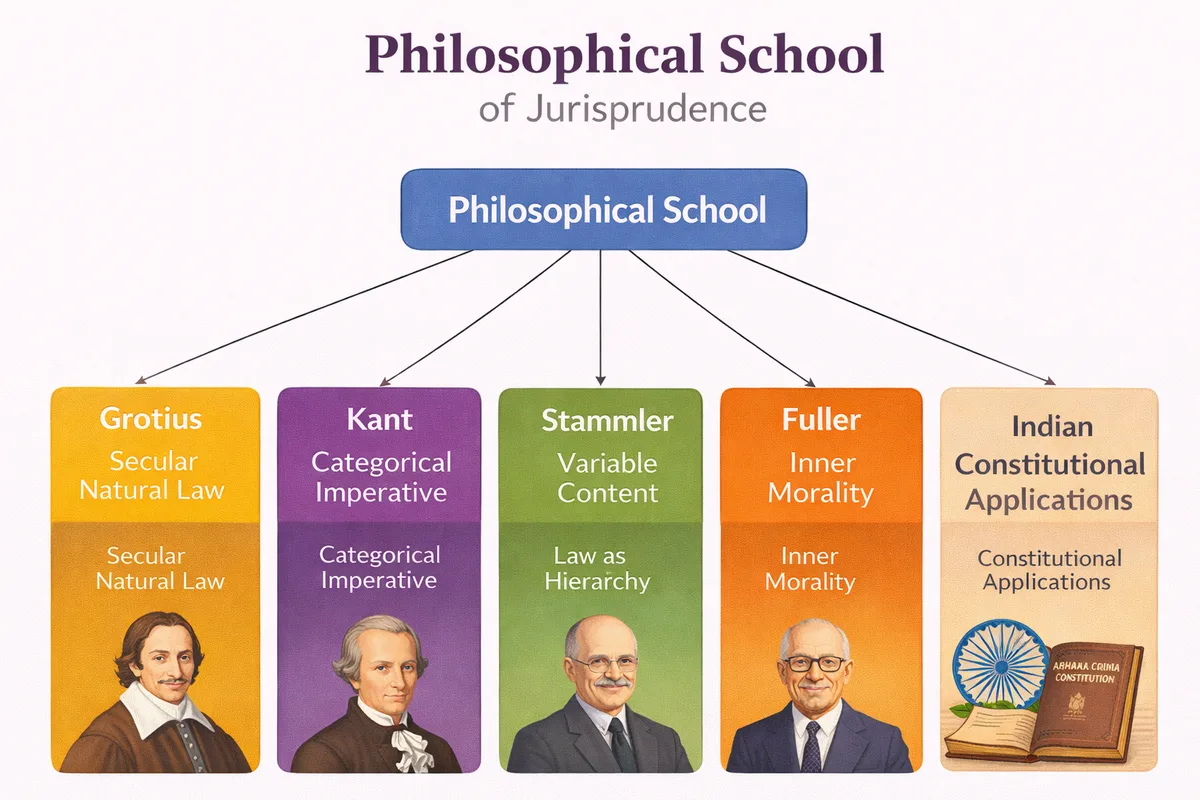
Legal Framework
| Element | Content |
|---|---|
| Also called | Natural Law School, Ethical School |
| Central claim | There exists a higher law (natural/divine/rational) against which positive law must be measured |
| Method | Evaluative law as it OUGHT to be |
| Key maxim | Lex injusta non est lex an unjust law is not law |
| Distinguishes from | Analytical school (law as it IS) and Historical school (law as it EVOLVED) |
| Periods | Ancient (Greek/Roman), Medieval (Aquinas), Modern (Grotius, Locke, Kant) |
Evolution of Natural Law
Ancient Period (Greek and Roman)
| Thinker | Contribution |
|---|---|
| Heraclitus | First to suggest a universal natural order governing all things |
| Socrates | Distinguished human law from a higher moral law discoverable by reason |
| Plato | Justice = each part of society performing its proper function; ideal law exists in the realm of Forms |
| Aristotle | Natural justice is universal and unchanging; contrasted with conventional justice (varies by society) |
| Stoics | Universal reason (logos) governs all beings; all humans are equal by nature; cosmopolitan natural law |
| Cicero (Roman) | "True law is right reason in agreement with nature; it is universal, unchanging, and everlasting" |
Medieval Period (Theological Natural Law)
| Thinker | Contribution |
|---|---|
| St. Augustine | Lex aeterna (eternal law of God) → lex naturalis (natural law known through reason) → lex humana (human law). Human law that contradicts eternal law is not binding. |
| St. Thomas Aquinas | Four types of law: (1) Eternal law (God's plan), (2) Natural law (participation of rational creatures in eternal law), (3) Divine law (scripture), (4) Human law (specific rules for community). Human law must derive from natural law. |
Modern Period (Secular Natural Law)
| Thinker | Contribution |
|---|---|
| Hugo Grotius (1583-1645) | Secularised natural law grounded it in REASON, not God. "Natural law would exist even if God did not exist." Father of international law. |
| Thomas Hobbes (1588-1679) | State of nature = war of all against all. Natural law = self-preservation. Social contract: surrender rights to sovereign for security. |
| John Locke (1632-1704) | Natural rights (life, liberty, property) exist BEFORE government. Government's purpose = protect natural rights. If government violates rights → right of revolution. |
| Jean-Jacques Rousseau (1712-1778) | Social contract = general will. Law must express the collective will for the common good. |
| Immanuel Kant (1724-1804) | Categorical imperative: "Act only according to a maxim that you can will to be a universal law." Law must respect human autonomy and dignity. |
Key Principles of Natural Law
| Principle | Content |
|---|---|
| Higher law exists | Above and beyond positive (man-made) law |
| Discoverable by reason | All rational humans can recognise natural law |
| Universal | Applies to all humans regardless of nation, time, or culture |
| Immutable | Does not change with time or place (core principles are permanent) |
| Standard for positive law | Positive law MUST conform to natural law to be valid |
| Unjust law = no law | Law that violates natural justice has no binding force |
Why: Natural law provides a CRITICAL function: it gives citizens a standard to JUDGE their own government's laws. Without it, any law enacted by proper procedure is "valid" regardless of content (Nazi law, apartheid, slavery). Natural law says: "No some things are so fundamentally wrong that no sovereign can make them 'law.'" This is the philosophical foundation of fundamental rights, judicial review, and the Nuremberg trials.
Aquinas's Four Types of Law
| Type | Source | Content | Example |
|---|---|---|---|
| Eternal Law | God's reason | The divine governance of all creation | Laws of nature, moral order |
| Natural Law | Human reason participating in eternal law | Universal moral principles accessible to rational beings | "Do not kill," "Do justice" |
| Divine Law | Scripture/revelation | Specific guidance from God beyond reason | Ten Commandments, Quran |
| Human Law | Legislature/sovereign | Specific rules for a community, derived from natural law | Indian Penal Code, Contract Act |
Why: Aquinas's hierarchy explains HOW positive law connects to morality. Human law is not arbitrary it must be DERIVED from natural law (which is itself a participation in eternal law). A human law that contradicts natural law (e.g., "slavery is lawful") is not truly law it is "a corruption of law" (corruptio legis).
Locke's Natural Rights Theory
| Element | Content |
|---|---|
| State of nature | Pre-political condition where humans are free and equal |
| Natural rights | Life, liberty, and property exist BEFORE government |
| Social contract | People form government to PROTECT (not create) natural rights |
| Limited government | Government's authority is limited to what the contract grants |
| Right of revolution | If government systematically violates natural rights, people may overthrow it |
| Influence | American Declaration of Independence, French Declaration of Rights, Indian Constitution (Part III) |
Illustrations
-
Natural law in Indian constitutional practice: Art.21: "No person shall be deprived of his life or personal liberty except according to procedure established by law." In Maneka Gandhi (1978), the Supreme Court held that the "procedure" must be "fair, just, and reasonable" not ANY procedure Parliament prescribes. This imports NATURAL LAW into positive law interpretation: even a validly enacted statute is unconstitutional if its procedure violates natural justice. The Court did not say "Parliament's word is final" (Austin's positivism). It said: "There are standards ABOVE Parliament against which we measure legislation" (natural law).
-
Lex injusta non est lex (Nuremberg): Nazi Germany enacted laws authorising genocide (Nuremberg Laws, 1935). After WWII, Nazi officials argued: "We were following valid law our sovereign enacted these rules through proper procedure." The Nuremberg Tribunal rejected this: "There are standards of behaviour that transcend positive law. No law can authorise genocide." This is natural law in action a HIGHER standard by which positive law is judged. Without natural law theory, there is no philosophical basis for saying "that law was wrong even though it was validly enacted."
-
Grotius's secularisation (natural law without God): Before Grotius, natural law required belief in God (Aquinas: natural law = participation in eternal law of God). Problem: what about atheists? What about nations with different religions? Grotius said: "Natural law would have validity even if we were to suppose which cannot be done without great wickedness that there is no God." He grounded natural law in HUMAN REASON all rational beings can discover that murder, theft, and breach of promises are wrong, regardless of religious belief. This made natural law usable in INTERNATIONAL law (between nations of different faiths).
-
Locke's influence on Indian fundamental rights: Locke said: natural rights (life, liberty, property) exist BEFORE government. Government's ONLY purpose is to protect them. The Indian Constitution embodies this: Part III (Fundamental Rights) LIMITS what government can do, even through legislation. Art.13(2): "The State shall not make any law which takes away or abridges the rights conferred by this Part." This is Lockean natural rights constitutionalised certain rights are beyond the reach of even a democratically elected Parliament. The right to life (Art.21) is not GIVEN by the Constitution it is RECOGNISED as pre-existing.
Rudolf Stammler (1856-1938): Natural Law with Variable Content
| Aspect | Content |
|---|---|
| Problem | Traditional natural law claims universality but legal systems obviously differ across cultures: is natural law just Western morality imposed on everyone? |
| Solution | Natural law with variable content: universal FORMAL principles take different CONCRETE forms in different historical/cultural contexts |
| Universal form | Respect for persons, reciprocity, proportionality, consistency |
| Variable content | The specific rules implementing these principles vary with historical, cultural, and economic circumstances |
Example: The formal principle "respect for persons" generates different concrete rules in:
- Feudal society → protection of status relationships
- Commercial society → protection of contract rights
- Industrial society → protection of labour rights
- Digital society → protection of data/privacy
Indian relevance: Stammler's approach accommodates India's legal diversity within a unified constitutional framework. Different communities can have different personal laws while sharing overarching values of dignity, equality, and justice (Part III).
Criticism: Potentially self-contradictory, if content varies completely, what makes it "natural law"? The formal principles may be too abstract to guide concrete decisions.
Lon Fuller (1902-1978): The Inner Morality of Law
| Aspect | Content |
|---|---|
| Key work | The Morality of Law (1964) |
| Core idea | Law has an "inner morality": formal requirements that any genuine legal system must satisfy |
| Type | Procedural natural law: focuses on HOW law operates, not WHAT content it has |
| Debate | Hart-Fuller debate (1958) on whether Nazi law was truly "law" |
Fuller's Eight Principles of Legality
A legal system must satisfy these requirements. Failure makes the system not merely bad law but no law at all:
| # | Principle | Requirement | Violation Example |
|---|---|---|---|
| 1 | Generality | Rules must be general, not ad hoc commands | Targeting specific individuals by name |
| 2 | Publicity | Rules must be published and accessible | Secret laws |
| 3 | Prospectivity | No retroactive legislation | Punishing acts that were legal when done |
| 4 | Clarity | Rules must be understandable | Incomprehensible vague language |
| 5 | Consistency | Rules cannot contradict each other | Simultaneous conflicting requirements |
| 6 | Possibility | Rules must not require the impossible | Demanding compliance that cannot be achieved |
| 7 | Constancy | Rules cannot change too frequently | Daily changes preventing reliance |
| 8 | Congruence | Official action must match announced rules | Government ignoring its own laws |
Memory Aid: GPPCCP CC: Generality, Publicity, Prospectivity, Clarity, Consistency, Possibility, Constancy, Congruence
Why These Are Moral (Not Merely Technical)
These requirements RESPECT HUMAN AGENCY: they treat people as rational beings capable of understanding and following rules, not objects to be manipulated. A system of secret, retroactive, contradictory rules treats citizens as pawns, not persons with dignity.
Hart-Fuller Debate (1958)
| Position | Hart | Fuller |
|---|---|---|
| Nazi law was... | Legally valid (properly enacted) though morally evil | Not genuinely "law": violated law's inner morality |
| Immoral law... | Is still law; condemn morally but accept legal status | Fails so fundamentally it loses the character of law |
| Implication | Separate moral condemnation from legal analysis | Law's concept itself has moral requirements |
Indian application: Fuller's principles appear in constitutional requirements: Art. 20(1) prohibits retroactive criminal laws (prospectivity), Art. 14 requires non-arbitrary general rules (generality), Art. 19(2)-(6) require "reasonable" restrictions (clarity and possibility).
Strong vs. Weak Natural Law
| Version | Claim | Implication |
|---|---|---|
| Strong | Extremely unjust laws are NOT legally valid at all | Courts should refuse to apply them |
| Weak | Extremely unjust laws may be valid but lack moral authority | Citizens may be justified in disobedience |
Substantive vs. Procedural Natural Law
| Type | Focus | Example | Criticism |
|---|---|---|---|
| Substantive | WHAT content law must have (specific rights, duties, values) | "Law must protect right to life" (Locke, Aquinas) | Moral disagreement: whose values? |
| Procedural | HOW law must operate (formal qualities) | "Law must be clear, public, prospective" (Fuller) | Necessary but may be insufficient: a clear, public law can still be evil |
Indian Application of Natural Law
| Theme | Natural Law at Work |
|---|---|
| Basic structure doctrine | Kesavananda Bharati (1973): some constitutional features cannot be destroyed even by valid amendment: substantive limits transcend procedure |
| Art. 21 expansion | Unenumerated rights (privacy, dignity, clean environment) recognised because inherent in human dignity, not textually explicit |
| Constitutional morality | Navtej Singh Johar (2018): dignity principles constrain legislative power regardless of democratic majorities |
| Reasonable restrictions | Art. 19(2)-(6): restrictions on rights must be "reasonable": imports moral evaluation into positive law |
| Art. 14 non-arbitrariness | Every state action must have rational basis: prevents arbitrary power even when technically legal |
Criticisms of the Natural Law School
| Criticism | Source | Content |
|---|---|---|
| Vague and uncertain | Positivists | What IS natural law? Different thinkers define it differently. No agreement on content. |
| Who determines its content? | Critics | Medieval: Church. Enlightenment: philosophers. Today: judges? The arbitrariness of interpretation undermines certainty. |
| Used to justify contradictions | Historical evidence | Natural law has been used to justify BOTH revolution (Locke) AND absolute monarchy (divine right of kings) a theory that justifies everything explains nothing. |
| No mechanism of enforcement | Analytical school | Even if natural law exists, without institutional enforcement it remains aspiration, not law. |
| Cultural relativism | Anthropologists | "Universal moral principles" often reflect Western/Christian values not truly universal across all cultures. |
| Confuses law and morality | Hart | Not everything morally wrong should be legally prohibited; not everything legal is moral. The boundary matters. |
Recall Check
- What is the central claim of the natural law school?
- Explain Aquinas's four-fold classification of law.
- How does Locke's theory of natural rights influence modern constitutionalism?
Key Cases
A.K. Gopalan v. State of Madras (1950) AK Gopalan v State of Madras 1950
Citation: AIR 1950 Supreme Court 27
Rule: Procedure established by law in Art.21 means any enacted law; fairness or reasonableness is not required. (Overruled by Maneka Gandhi, 1978.)
Distinctions
| Aspect | Philosophical (Natural Law) School | Analytical (Positivist) School |
|---|---|---|
| Law's source | Reason/nature/God | Sovereign's command |
| Method | Evaluative (law as it OUGHT to be) | Descriptive (law as it IS) |
| Unjust law | Not law at all | Still valid law (just immoral) |
| Law-morality | Inseparable (law must conform to morality) | Separate (law's existence ≠ its merit) |
| Validity test | Conformity with higher principles | Proper enactment by authority |
| Focus | Content of law (is it just?) | Form of law (was it properly made?) |
| Aspect | Natural Law School | Historical School |
|---|---|---|
| Source of law | Universal reason | National custom (Volksgeist) |
| Universality | Law is universal (same for all nations) | Law is national (each nation has unique law) |
| Change | Reform is possible (reason can improve law) | Change must be organic (not imposed) |
| Codification | Possible (reason can design codes) | Cautious (wait for maturity) |
| Morality | Prescriptive (law MUST be moral) | Descriptive (law reflects existing social norms) |
Flashcards
What is the central claim of the natural law school?
A higher law (discoverable by reason) exists above positive law. Positive law is valid only if it conforms to natural law. An unjust law is no law (lex injusta non est lex).
Who secularised natural law and how?
Hugo Grotius. He grounded natural law in HUMAN REASON rather than God "natural law would exist even if God did not exist." This made it applicable across religious boundaries.
State Aquinas's four types of law.
(1) Eternal law (God's plan), (2) Natural law (rational participation in eternal law), (3) Divine law (revelation/scripture), (4) Human law (community rules derived from natural law).
What is Locke's social contract theory?
Humans have natural rights (life, liberty, property) in the state of nature. They form government through social contract to PROTECT these rights. Government that violates rights may be overthrown.
How does natural law relate to Indian fundamental rights?
Part III embodies Lockean natural rights rights exist prior to government and LIMIT what the state can do. Art.13 voids laws violating fundamental rights. Art.21 recognises (not creates) the right to life.
What is the maxim *lex injusta non est lex*?
"An unjust law is not law" the central claim that validity requires conformity with higher moral standards, not just proper enactment.
What is the main criticism of natural law?
Vagueness, no agreed content. Different thinkers define "natural law" differently, and the same theory has justified contradictory positions (both revolution and monarchy).
What is Stammler's "natural law with variable content"?
Universal formal principles of justice (respect for persons, reciprocity, proportionality, consistency) take different concrete forms in different historical and cultural contexts. The form is universal; the content varies with society.
What are Fuller's eight principles of legality?
(1) Generality, (2) Publicity, (3) Prospectivity, (4) Clarity, (5) Consistency, (6) Possibility, (7) Constancy, (8) Congruence. Systems severely failing these are not genuine legal systems.
What is the difference between substantive and procedural natural law?
Substantive specifies WHAT content law must have (specific rights, values). Procedural (Fuller) specifies HOW law must operate (clarity, publicity, consistency) without determining specific content. Procedural avoids moral disagreements about values.
How does Fuller's theory apply to Nazi Germany?
Nazi Germany violated most of Fuller's eight principles: secret laws, retroactive punishment, contradictory rules, divergence between announced rules and official action. It was not merely bad law but not a genuine legal system at all.
Exam Scenario
"Natural law is the grammar of law." Discuss the contribution of the Natural Law School to legal thought, examining its strengths and limitations.
The metaphor: As grammar provides structure and rules that make language meaningful (without grammar, words are random noise), natural law provides moral structure that makes positive law LEGITIMATE (without natural law standards, any tyrannical enactment is "law"). Natural law is the grammar that separates meaningful law from arbitrary commands.
Contributions:
(1) Foundation of human rights: The idea that some rights are "natural" (pre-political, inalienable) is the philosophical basis for constitutionalism. Indian Part III, UN Declaration of Human Rights (1948), American Bill of Rights all rest on the premise that rights are not CREATED by government but RECOGNISED. Without natural law, there is no basis for saying "even a democratically elected Parliament cannot authorise torture."
(2) Standard for judicial review: When the Supreme Court strikes down a law as "arbitrary" (Art.14) or violating "basic structure" (Kesavananda Bharati, 1973), it is applying a HIGHER standard against which positive law is judged. This is natural law constitutionalised. Without it, parliamentary sovereignty would be absolute.
(3) International law: Grotius used natural law to construct international law (rights of nations, law of war, freedom of seas) when no sovereign existed to "command" nations. International law still rests on natural law foundations treaties are binding because pacta sunt servanda (a natural law principle: promises must be kept).
(4) Reform and revolution: Every progressive reform (abolition of slavery, women's suffrage, decolonisation) was argued in natural law terms: "This existing law is UNJUST because it violates natural equality." Without the natural law claim that existing law CAN be wrong, reform has no theoretical foundation.
Limitations:
(1) Content uncertainty: Natural law claims universality but delivers disagreement. Aquinas says natural law requires procreation (opposing contraception). Locke says natural law requires property rights (opposing socialism). Kant says natural law requires human autonomy (supporting both). Which version is "correct"?
(2) Historical misuse: Natural law justified monarchy (divine right), revolution (Locke), slavery (Aristotle's "natural slaves"), and abolition (anti-slavery movement). A theory flexible enough to justify everything has limited analytical value.
(3) Enforcement gap: Even if natural law exists, it has no institutional mechanism. Positive law has courts, police, prisons. Natural law has only moral persuasion until it is CONSTITUTIONALISED (as in India), it remains aspiration.
Conclusion: Natural law is indispensable as a CRITICAL function it prevents legal positivism from becoming moral blindness. But it is insufficient as a COMPLETE theory it needs positive law institutions to give it force. The strongest legal systems (India's Constitution) combine both: natural law principles (Part III) enforced through positive law institutions (Supreme Court under Art.32). Neither school alone is adequate; the synthesis is the achievement of modern constitutionalism.