Jurisprudence is the theoretical study of law not what the law IS on any specific topic, but what law ITSELF is: its nature, sources, functions, and concepts. The term derives from Latin jurisprudentia (juris = law + prudentia = knowledge/skill), meaning "knowledge of law" or "skill in law."
Legal Framework
| Element | Content |
|---|---|
| Etymology | Latin jurisprudentia = knowledge of law (juris + prudentia) |
| Salmond | "Jurisprudence is the science of the first principles of the civil law" |
| Austin | "Jurisprudence is the philosophy of positive law" |
| Holland | "Jurisprudence is the formal science of positive law" |
| Keeton | "Jurisprudence is the study and systematic arrangement of the general principles of law" |
| Scope | NOT concerned with particular rules (that is substantive law) but with the NATURE, STRUCTURE, and CONCEPTS underlying all rules |
 |
Definitions Compared
| Jurist | Definition | Emphasis | Criticism |
|---|---|---|---|
| Austin | "Philosophy of positive law" | Only state-made law (commands of sovereign); excludes morality, divine law | Too narrow: excludes customary law, international law, constitutional limits, and moral dimensions |
| Salmond | "Science of first principles of civil law" | Foundation concepts: right, duty, ownership, possession, not specific rules | "Civil law" ambiguous (does not mean civil vs criminal; means positive law of the state vs natural law): most cited in Indian law schools |
| Holland | "Formal science of positive law" | FORMAL = structure/classification; ignores content (like grammar studies language structure, not meaning) | Too abstract: by focusing only on form, ignores social context, purposes, and effects of law |
| Pound | "Science of social engineering through law" | Functional: law as tool for balancing competing interests | Collapses jurisprudence into sociology; uncertain balancing principles |
| Bentham | Expository (what law IS) + Censorial (what law OUGHT to be) | Both analytical and evaluative study are legitimate | Division itself remains useful even if Bentham's utilitarianism is contested |
| Dias & Hughes | "Knowledge of law and its connection with other disciplines" | Interdisciplinary character | : |
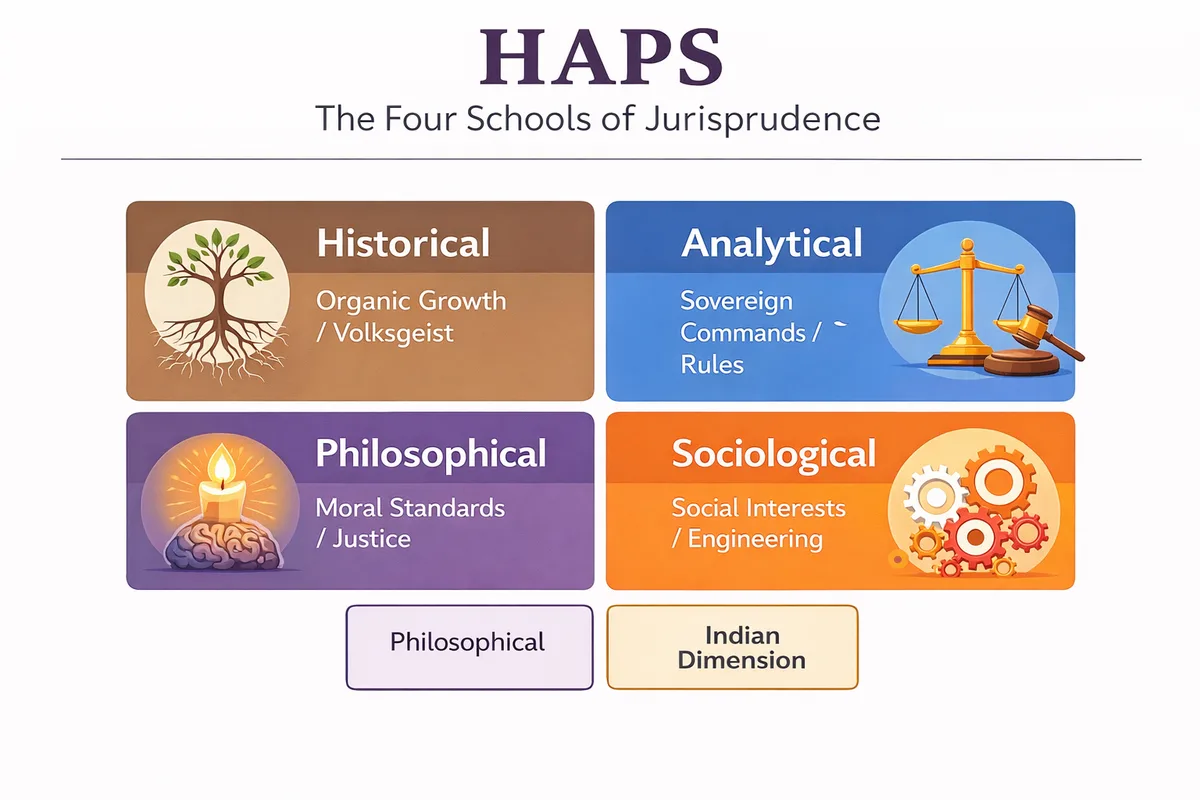
Why: The variation in definitions reflects a deeper disagreement about WHETHER jurisprudence should be purely analytical (Austin, Holland: study law's structure only) or also evaluative (Pound: assess law's social effectiveness). This is the fundamental division that produces the different schools. Salmond's definition is most cited in Indian courts because it captures jurisprudence's actual scope, studying foundations rather than details, without committing exclusively to either approach.
General vs. Particular Jurisprudence
| Aspect | General Jurisprudence | Particular Jurisprudence | Comparative Jurisprudence |
|---|---|---|---|
| Scope | Principles COMMON to ALL legal systems | Principles of ONE specific legal system | Systematic comparison of MULTIPLE systems |
| Example | "What is a legal right?" (applies everywhere) | "How does Indian law define 'right'?" (India-specific) | "How do common law and civil law systems differ on precedent?" |
| Proponent | Austin first distinguished the two | Applied in all national legal studies | Modern development |
| Content | Universal concepts: right, duty, law, sovereignty, possession | National concepts: fundamental rights (Art.12-35), Hindu law of succession | Identifies truly universal features vs culturally specific ones |
| Method | Comparative, abstract, philosophical | Doctrinal, country-specific | Cross-system analysis |
| Relationship | Foundation for particular jurisprudence | Application of general concepts to specific system | Tests generality of "general" principles |
Memory Aid: GPC: General (Global principles) → Particular (Place-specific) → Comparative (Contrasts systems)
Why: Austin argued that certain concepts (right, duty, law, sovereignty) exist in EVERY legal system studying these universals is "general jurisprudence." Studying how India specifically constructs "right" (Part III Constitution) is "particular jurisprudence." The general informs the particular; the particular tests the general.
Nature of Jurisprudence
| Question | Answer |
|---|---|
| Is it a science? | YES in the sense of systematic knowledge; NO in the sense of empirical natural science (cannot experiment on law) |
| Is it philosophy? | YES: it asks fundamental questions (What is law? What justifies obligation?) |
| Is it art? | Partially: it develops skills of legal reasoning and argument |
| Is it normative or descriptive? | BOTH: analytical jurisprudence is descriptive (what law IS); philosophical jurisprudence is normative (what law OUGHT to be) |
Memory Aid, SPA: Jurisprudence is simultaneously:
- Science: Systematises and studies law as it is (Austin, Holland, Kelsen)
- Philosophy: Probes what law ought to be (Natural Law thinkers)
- Art: Applies principles in practice (Roman tradition of jurisprudentia)
Why the synthesis: As Dias observed, "Jurisprudence is a science because it is systematised, a philosophy because it involves value judgments, and an art because it guides practical action." No single characterisation captures the discipline fully.
Relationship with Other Disciplines
| Discipline | Relationship to Jurisprudence |
|---|---|
| Sociology | Law in society: how social forces shape law and law shapes society |
| Philosophy | Moral foundations: justice, natural rights, legitimacy of authority |
| Political Science | Sovereignty, state, governance: who makes law and why they have authority |
| History | Evolution: how legal concepts developed over time |
| Economics | Law's economic consequences: efficiency, property rights, market regulation |
| Psychology | Criminal behaviour, mens rea, intention: how mind relates to legal responsibility |
Purpose and Function of Law
Why does law exist? Different schools answer differently, but certain purposes appear consistently:
| Function | Explanation |
|---|---|
| Maintaining order | Without law, disputes resolve through force; law provides peaceful mechanisms |
| Protecting rights | Safeguards individual and group rights against violation by others or by the state |
| Ensuring justice | Provides remedies for wrongs; aims to treat similar cases similarly |
| Regulating conduct | Sets standards for behaviour: what members of society may, must, and must not do |
| Enabling social change | Instrument for reform, abolishing practices, creating new rights, redistributing resources |
Pound's Social Engineering: Law should recognise, classify, and balance competing interests, individual interests (life, property, reputation), public interests (state security, morality), and social interests (general welfare, conservation), to maximise social welfare with minimum friction and waste.
Illustrations
-
General vs Particular jurisprudence (the difference in one example): General jurisprudence asks: "What IS ownership? What does it mean to 'own' something in ANY legal system?" The answer (right to use, dispose, exclude, unlimited duration) applies whether you're in India, England, or Japan. Particular jurisprudence asks: "How does INDIAN law handle co-ownership of Hindu Undivided Family property?" The answer (Mitakshara coparcenary, right by birth, not by succession) applies only in India under Hindu law. Same concept (ownership), different level of abstraction. General gives you the template; particular fills in national details.
-
Why jurisprudence matters to a practising lawyer: A student asks: "I want to argue cases, not philosophise.
Why study jurisprudence?" Answer: When the Supreme Court in Maneka Gandhi (1978) said "procedure established by law" (Art.21) must be "fair, just, and reasonable," it was DOING jurisprudence importing natural law philosophy into positive law interpretation. When a court debates whether a corporation has "fundamental rights" that's jurisprudence (theory of legal personality). Every hard constitutional case is decided by jurisprudential reasoning disguised as legal argument.
-
Austin vs Salmond (the scope debate): Austin says jurisprudence studies ONLY "positive law" (law actually laid down by political superiors). So: a law professor studying "should India have a Uniform Civil Code?" is NOT doing jurisprudence under Austin that's legislation or politics. Salmond says jurisprudence studies "first principles" which INCLUDES asking what law SHOULD be. The difference: Austin restricts jurisprudence to describing law; Salmond permits jurisprudence to evaluate law. This is why Austin's school is called "analytical" (descriptive) and the philosophical school (following Salmond's broader view) is called "normative" (evaluative).
-
Holland's "formal science" analogy: Holland compared jurisprudence to grammar. Grammar doesn't care about the CONTENT of sentences (whether you're writing a love letter or a death threat). Grammar cares about STRUCTURE (subject-verb-object, tense, agreement). Similarly, Holland's jurisprudence doesn't care about what specific laws SAY (murder gets life imprisonment vs. murder gets 10 years). It cares about STRUCTURE: What is a "right"? What is "duty"? How do "rights" relate to "remedies"? Like grammar for language, jurisprudence is grammar for law.
Recall Check
- Distinguish Austin's definition of jurisprudence from Salmond's.
- What is the distinction between general and particular jurisprudence?
- Why did Holland describe jurisprudence as a "formal" science?
Distinctions
| Aspect | Jurisprudence | Substantive Law |
|---|---|---|
| Concern | Nature, structure, concepts of law in GENERAL | Specific rules on specific subjects |
| Example | "What is a right?" | "What are fundamental rights under Art.12-35?" |
| Method | Philosophical, analytical, comparative | Doctrinal, statutory interpretation |
| Output | Theories (natural law, positivism) | Rules (murder = life imprisonment) |
| Universality | Aims for universal principles | Country-specific, time-specific |
| Aspect | General Jurisprudence | Particular Jurisprudence |
|---|---|---|
| Scope | Universal legal concepts | One legal system's concepts |
| Method | Comparative, abstract | Doctrinal, system-specific |
| Example | Nature of sovereignty | Indian sovereignty under the Constitution |
| Utility | Foundation for ALL legal systems | Practical use in one system |
Flashcards
What is the etymological meaning of "jurisprudence"?
From Latin jurisprudentia juris (law) + prudentia (knowledge/skill) = knowledge of law or skill in law.
What is Austin's definition of jurisprudence?
"The philosophy of positive law" systematic study of law as actually laid down by political superiors.
What is Salmond's definition?
"The science of the first principles of the civil law" study of foundational concepts (right, duty, ownership) rather than particular rules.
How did Holland describe jurisprudence?
As "the formal science of positive law" studying the STRUCTURE and classification of law, not its content (like grammar for language).
Distinguish general from particular jurisprudence.
General: universal principles common to all legal systems (What is a right?). Particular: principles of one specific system (How does Indian law define right?).
Is jurisprudence descriptive or normative?
Both analytical jurisprudence describes what law IS; philosophical jurisprudence evaluates what law OUGHT to be.
Exam Scenario
"Jurisprudence is the eye of law." Discuss the meaning and significance of jurisprudence as a discipline, distinguishing between general and particular jurisprudence.
Meaning: Jurisprudence is the theoretical and philosophical study of law not the study of what specific rules say, but the study of what LAW ITSELF is: its nature, sources, authority, and foundational concepts. Laski called it "the eye of law" because it provides the VISION through which specific legal rules are understood, interpreted, and evaluated. Without jurisprudence, law is blind rule-following; with it, law has intellectual coherence.
Definitions: Austin defined it as "philosophy of positive law" (restricting scope to state-made law). Salmond broadened it to "first principles of civil law" (including foundational concepts). Holland narrowed it to "formal science" (structure, not content). Pound expanded it to "social engineering" (law's social function). Each definition reflects a school's priorities.
General vs. Particular:
- General jurisprudence studies concepts COMMON to all legal systems: right, duty, ownership, sovereignty, persons. These universals exist whether the system is Indian, English, Islamic, or Roman. Austin argued that since ALL legal systems have "sovereignty," "rights," and "obligations," studying these in the abstract is general jurisprudence.
- Particular jurisprudence applies these general concepts to ONE system: how does the Indian Constitution construct sovereignty (popular sovereignty under Preamble, not Parliamentary sovereignty)? How does Hindu law construct ownership (coparcenary vs. separate property)?
Significance: (1) Provides vocabulary terms like "right," "duty," "person," "sanction" gain precise meaning through jurisprudence. (2) Enables reform understanding WHY law exists (social engineering, justice, order) helps evaluate whether specific rules achieve their purpose. (3) Resolves hard cases when statute is silent or ambiguous, courts resort to first principles (natural justice, rule of law, fairness) all products of jurisprudential thought. (4) Connects law to society sociological jurisprudence explains how law interacts with economics, politics, and morality.
Conclusion: Jurisprudence is to law what philosophy is to science it asks the foundational questions that practitioners take for granted. Without it, lawyers know WHAT the law says but not WHY it exists, WHERE it derives authority, or HOW it should develop. The "eye of law" metaphor captures this: jurisprudence gives law sight, direction, and purpose.