The Historical School holds that law is not made by sovereign command or discovered by reason it EVOLVES organically from the spirit, habits, and customs of a people. Law is a product of history, not legislation. It grows like language: unconsciously, gradually, and collectively.
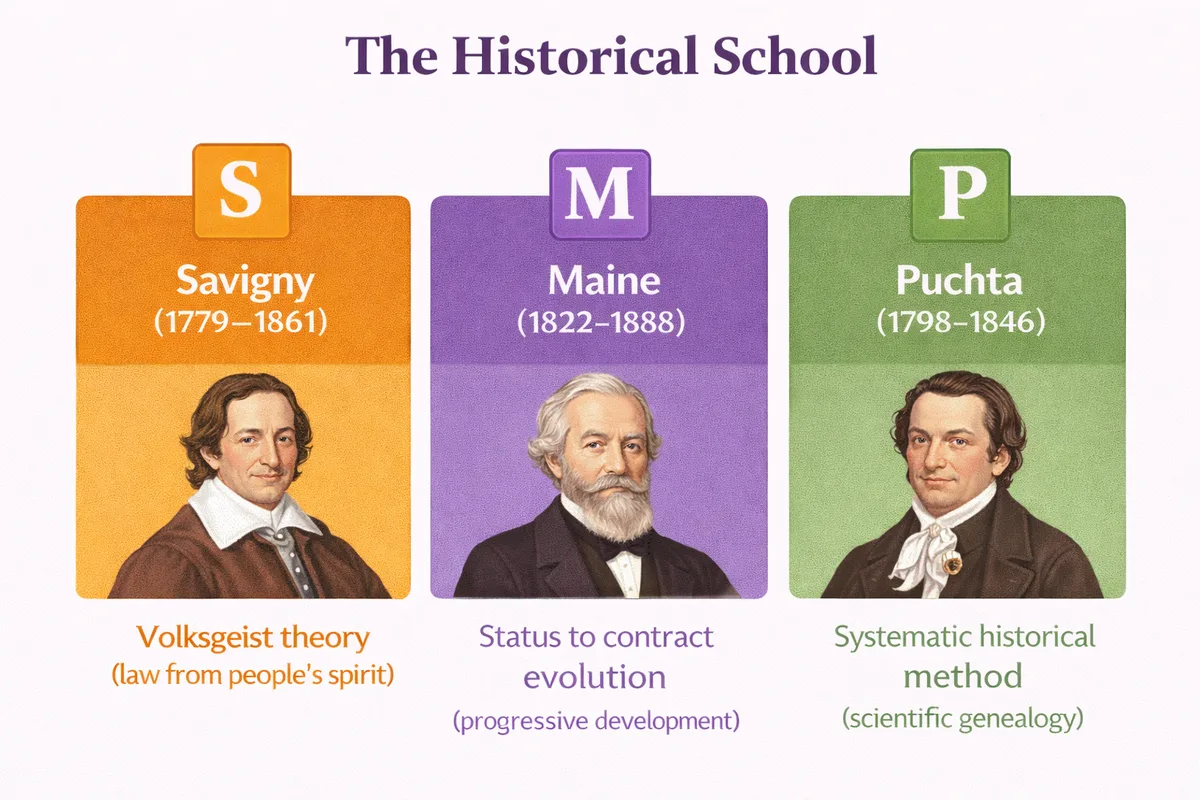
Legal Framework
| Element | Content |
|---|---|
| Central claim | Law is found, not made it evolves from the Volksgeist (spirit of the people) |
| Method | Historical study of how legal institutions evolved over time |
| Against | Natural law (law from reason) AND analytical school (law from sovereign command) |
| Founders | Friedrich Carl von Savigny (1779-1861), Georg Friedrich Puchta |
| English branch | Sir Henry Maine (1822-1888) |
| German branch | Savigny, Puchta |
| Context | Reaction against Napoleonic codification (early 19th century Germany) |
Friedrich Carl von Savigny (1779-1861)
| Aspect | Content |
|---|---|
| Title | Father of the Historical School |
| Key work | Of the Vocation of Our Age for Legislation and Jurisprudence (1814) |
| Context | Thibaut proposed a German Civil Code (like Napoleon's Code Civil). Savigny opposed. |
| Core concept | Volksgeist the spirit/consciousness of the people |
Savigny's Volksgeist Theory
| Principle | Content |
|---|---|
| Law is not made | Law evolves organically from the common consciousness of the people |
| Like language | Just as grammar is not "invented" but develops from people's speech habits, law develops from people's social habits |
| Custom precedes legislation | Legislation merely DECLARES what custom has already established |
| National character | Each nation's law reflects its unique history, culture, and character no universal law code possible |
| Against codification | Premature codification FREEZES law and prevents organic growth |
| Three stages | (1) Customary law (people's practice), (2) Jurist's law (scholars systematise custom), (3) Legislative law (codification only when society is mature) |
Why: Savigny wrote in reaction to the French Revolution's belief that REASON could redesign law from scratch (Code Napoleon). Savigny argued: you cannot transplant French law into Germany because law is NOT universal it is tied to a nation's unique history. German law must grow from German customs, not be imposed from French rationalism.
Sir Henry Maine (1822-1888)
| Aspect | Content |
|---|---|
| Title | Founder of comparative jurisprudence and legal anthropology |
| Key work | Ancient Law (1861) |
| Core contribution | Progressive societies move from STATUS to CONTRACT |
| Method | Comparative historical analysis (Roman, Hindu, Celtic, Germanic law) |
Maine's Thesis: Status to Contract
| Stage | Characteristic | Example |
|---|---|---|
| Status (ancient/static society) | Rights and duties determined by BIRTH family, caste, tribe | Hindu joint family: rights depend on being born into the family |
| Contract (progressive/modern society) | Rights and duties determined by AGREEMENT individual choice | Modern employment: rights depend on the contract you negotiate |
| Aspect | Status-based Society | Contract-based Society |
|---|---|---|
| Basis of rights | Birth, family, caste | Individual agreement |
| Unit of society | Family (pater familias rules) | Individual |
| Law is | Customary, unwritten, collective | Statutory, written, individual |
| Example | Ancient Roman patria potestas (father's absolute authority) | Modern contract of employment |
| Change | Very slow (tradition-bound) | Rapid (legislative reform) |
Why: Maine observed that in ALL ancient societies (Roman, Hindu, Celtic), a person's legal position was determined by family status (born free or slave, born male or female, born into which caste). Modern societies shifted to individual agreement as the basis of obligation. This is "progressive" because it reflects increasing individual autonomy.
Maine's Instruments of Legal Change
| Instrument | Function | Example |
|---|---|---|
| Legal fictions | Pretend something is what it is not to achieve reform without admitting change | Adoption (fiction that adopted child IS natural child) |
| Equity | Supplement rigid law with flexible fairness | Court of Chancery correcting common law rigidity |
| Legislation | Deliberate, conscious law reform | Parliament amending outdated law |
Georg Friedrich Puchta (1798-1846)
| Contribution | Content |
|---|---|
| Systematised Savigny | Developed Volksgeist into a hierarchy |
| Three sources of law | (1) Custom (direct expression of Volksgeist), (2) Legislation (indirect expression through state), (3) Jurist's science (scholarly systematisation) |
| All three trace back | To the Volksgeist as ultimate source |
Puchta's Stages of Customary Law Development
| Stage | Description | Example |
|---|---|---|
| 1. Spontaneous practice | Communities develop regular ways of handling problems without conscious legal intention | Village resolving water disputes by traditional turns |
| 2. Normative recognition | Practices acquire binding force: community members recognise them as obligatory standards | "It is wrong to take water out of turn" |
| 3. Judicial application | Courts begin applying customary standards, giving them more precise articulation | Revenue courts recognising customary irrigation rights |
| 4. Juristic systematisation | Scholars organise customs into coherent frameworks, preparing for codification | Dharmashastra scholars systematising Hindu practices |
This analysis explains how unwritten custom becomes written law, not through legislative creation but through gradual formalisation of existing practices.
Indian Application
| Theme | Historical School Insight |
|---|---|
| Recognition of personal laws | Hindu and Muslim laws evolved organically over centuries: recognised rather than imposed (respects Volksgeist) |
| Difficulty of Uniform Civil Code | Art. 44 remains unimplemented because imposed uniformity contradicts deep community consciousness: Savigny predicted this |
| Evolution of Hindu law | Shows all three Maine mechanisms: fictions (extending "joint family" to new situations), equity (judicial reform of discrimination), legislation (Hindu Code Bills 1955-56) |
| Tribal customary rights | Constitution (Fifth/Sixth Schedules) recognises tribal customs as law without sovereign command: pure Volksgeist |
| The reform tension | Constitution deliberately broke with oppressive traditions (sati, untouchability, gender discrimination), sometimes law must LEAD society, not just follow it |
The correct position for India: Law is PARTLY found (custom still matters, personal laws persist) and PARTLY made (Constitution reforms what custom cannot). Neither pure Volksgeist nor pure sovereign command explains Indian legal reality.
Criticisms of the Historical School
| Criticism | Source | Content |
|---|---|---|
| Volksgeist is vague | Analytical school | What exactly IS the "spirit of the people"? How do you identify it? In a diverse nation (India: 1000+ communities), whose "spirit" is the Volksgeist? |
| Ignores legislation | Positivists | Most modern law IS deliberately made (tax law, company law, environmental law) not organically evolved |
| Conservative bias | Reformers | If law should only grow from custom, how do you reform oppressive customs (sati, untouchability, child marriage)? |
| Status to contract oversimplified | Critics | Modern welfare state has re-introduced status (labour law protects workers BY STATUS as "workmen") |
| Custom can be unjust | Natural law | Customs like sati and untouchability evolved "organically" does that make them law? |
| Ignores power | Marxists | "Custom" often reflects the interests of the dominant class, not "the people" |
Illustrations
-
Volksgeist in Indian context (Hindu law): Hindu law evolved from Dharmashastra texts (Manu, Yajnavalkya) which themselves codified existing customs of Hindu society. For centuries, there was no "Parliament" enacting Hindu law it grew from the collective consciousness of Hindu society (joint family, ancestral property, caste duties). Savigny would say: Hindu law reflects the Volksgeist of Hindu civilisation.
BUT: In 1955-56, Parliament enacted the Hindu Code Bills (Marriage Act, Succession Act, Adoption Act) reforming 2000+ years of custom. Parliament ABOLISHED the Hindu joint family's absolute power, gave women inheritance rights, and permitted inter-caste marriage. If Volksgeist determined law, these reforms should have been IMPOSSIBLE (they contradicted existing "spirit"). They succeeded because LEGISLATION can override Volksgeist. Savigny's theory cannot adequately explain deliberate legislative reform against prevailing custom.
-
Status to Contract (Maine's thesis in Indian history): Pre-independence India (Status): A person's legal position depended on birth caste determined occupation (Brahmin = priest, Kshatriya = warrior, Shudra = service), family determined property rights (Hindu joint family), gender determined inheritance (women got nothing). Post-independence India (Contract): The Constitution abolished untouchability (Art.17), guaranteed equality (Art.14), permitted freedom of occupation (Art.19(1)(g)). Modern Indians negotiate employment contracts, marry by choice (Special Marriage Act), and own property individually.
BUT: Has India fully moved to "contract"? Labour law creates STATUS protections (Workmen under ID Act cannot be fired without government permission regardless of contract terms). Reservation creates STATUS-based rights (SC/ST/OBC get benefits by birth category). Maine would say: India is transitional partly status, partly contract. No society completes the transition perfectly.
-
Legal fictions (Maine's first instrument of change): Roman law said: only a Roman citizen can sue in Roman courts. Problem: Rome conquers Greece; Greek merchants need to sue in Roman courts. Solution: the Praetor Peregrinus PRETENDS the Greek is a Roman citizen ("let us proceed AS IF the Greek were a citizen"). Law changes WITHOUT admitting it has changed the fiction enables progress while preserving the appearance of continuity. In Indian law: "deemed" provisions are legal fictions ("corporate veil" = company deemed separate person from shareholders Salomon v. Salomon).
-
Why Savigny opposed codification (and was partly wrong): Savigny's argument (1814): "Germany is not ready for a code. Our legal science hasn't matured enough. Premature codification freezes law at an immature stage." What happened: Germany eventually codified in 1900 (BGB Bürgerliches Gesetzbuch). The code was brilliant precisely BECAUSE Germany waited 86 years. Savigny was right that PREMATURE codification is harmful (French Code imposed on conquered nations often failed). But he was wrong that codification is NEVER appropriate. India codified personal law in 1955-56 with great success despite conservative opposition using Savigny-like arguments ("our customs shouldn't be frozen into legislation").
Recall Check
- What is Savigny's concept of Volksgeist?
- State Maine's thesis on "status to contract."
- What are Maine's three instruments of legal change?
Key Cases
Durgah Committee, Ajmer v. Syed Hussain Ali (1961) Durgah Committee v Syed Hussain Ali 1961
Citation: AIR 1961 Supreme Court 1402
Rule: Custom has the force of law in personal law matters but yields to an express statutory provision
Distinctions
| Aspect | Historical School | Analytical School |
|---|---|---|
| Law comes from | The people (custom, Volksgeist) | The sovereign (command) |
| Law is | Found/discovered in social practice | Made/enacted by political authority |
| Custom | PRIMARY source law evolves from it | Not law until sovereign adopts it |
| Legislation | Secondary merely declares what custom established | Primary form of law |
| Method | Historical, comparative | Logical, conceptual |
| Focus | How law DEVELOPS over time | What law IS at a given moment |
| Criticism | Conservative (resists reform) | Formalistic (ignores society) |
| Aspect | Historical School | Natural Law School |
|---|---|---|
| Source of law | History, custom, national character | Reason, nature, divine order |
| Universality | Law is national (each nation has unique law) | Law is universal (same reason applies to all) |
| Morality | Descriptive (law reflects existing morality) | Normative (law must conform to higher morality) |
| Codification | Cautious (wait for organic maturity) | Possible (reason can design universal code) |
| Change | Gradual, organic, unconscious | Can be revolutionary (reason demands reform NOW) |
Flashcards
Who is the founder of the Historical School?
Friedrich Carl von Savigny (1779-1861). Sir Henry Maine is the English branch.
What is *Volksgeist*?
The "spirit of the people" the collective consciousness of a nation from which law organically evolves, like language evolves from speech habits.
What is Maine's "status to contract" thesis?
Progressive societies move from determining rights by BIRTH (status: family, caste) to determining rights by AGREEMENT (contract: individual choice).
What are Maine's three instruments of legal change?
(1) Legal fictions (pretend change hasn't happened), (2) Equity (supplement rigid law with fairness), (3) Legislation (deliberate conscious reform).
Why did Savigny oppose codification?
Premature codification freezes law at an immature stage, preventing organic growth. Law should be codified only when juristic science has fully systematised the nation's custom.
What is the main criticism of Volksgeist in a diverse nation like India?
India has 1000+ communities with different customs whose "spirit" is the Volksgeist? The concept assumes national homogeneity that does not exist in plural societies.
How does the historical school differ from the analytical school on custom?
Historical: custom is the PRIMARY source (law grows from it). Analytical: custom is not law until the sovereign adopts/sanctions it (Austin's view).
Exam Scenario
"Law is not made; it is found." Critically examine Savigny's Volksgeist theory with reference to Indian legal developments.
Savigny's theory: Law evolves organically from the spirit (Volksgeist) of a people their customs, practices, and shared consciousness. It is not deliberately manufactured by legislators. Legislation merely DECLARES what custom has already established. Savigny opposed codification as premature freezing of organic growth.
Support from Indian experience: (1) Hindu law evolved over millennia from Dharmashastra texts reflecting Hindu social practice no legislature "enacted" the Hindu joint family system. (2) Muslim personal law similarly grew from Quran, Hadith, and community practice codified minimally. (3) Agricultural customs of diverse communities (water rights, inheritance patterns) became "customary law" recognised by courts without legislative origin. (4) The Indian Evidence Act (S.13) and Code of Civil Procedure (S.8) both recognise custom as a source of law validating Savigny's insight.
Against the theory (Indian counter-evidence): (1) The Constitution itself is MADE, not found it was drafted in 2 years 11 months by a Constituent Assembly. It did not "evolve" from Indian custom (Art.14 equality contradicts caste custom; Art.17 abolishes untouchability which WAS custom). (2) Hindu Code Bills (1955-56) DELIBERATELY reformed 2000+ years of custom giving women inheritance rights, permitting inter-caste marriage, abolishing polygamy. If Volksgeist determined law, these reforms should have been impossible. They succeeded because LEGISLATION can override custom. (3) Labour legislation, environmental law, and technology law (IT Act 2000) have NO customary origin they are responses to modern challenges unknown to "the people's spirit." (4) In a diverse nation like India (Hindus, Muslims, Christians, tribals, 22+ languages), there is no SINGLE Volksgeist there are many competing community consciousnesses.
Conclusion: Savigny correctly identified that much law has customary origins and that legal transplants (imposing foreign law on unwilling people) often fail. But his theory is INCOMPLETE for modern India: (a) deliberate legislation is the dominant source of law today, (b) constitutional reform frequently CONTRADICTS prevailing custom, (c) national diversity makes a unitary Volksgeist fictional. The correct position is eclectic: law is PARTLY found (custom still matters) and PARTLY made (legislation reforms what custom cannot).