Precedent (judicial precedent) is a prior court decision that serves as an authority for deciding a later case with similar facts or legal issues. The doctrine of stare decisis ("stand by what has been decided") requires courts to follow earlier decisions of higher courts, creating consistency, predictability, and equality in the legal system.
Legal Framework
| Element | Content |
|---|---|
| Definition (Salmond) | "A precedent is a judicial decision which contains in itself a principle. The underlying principle forms its authoritative element the ratio decidendi." |
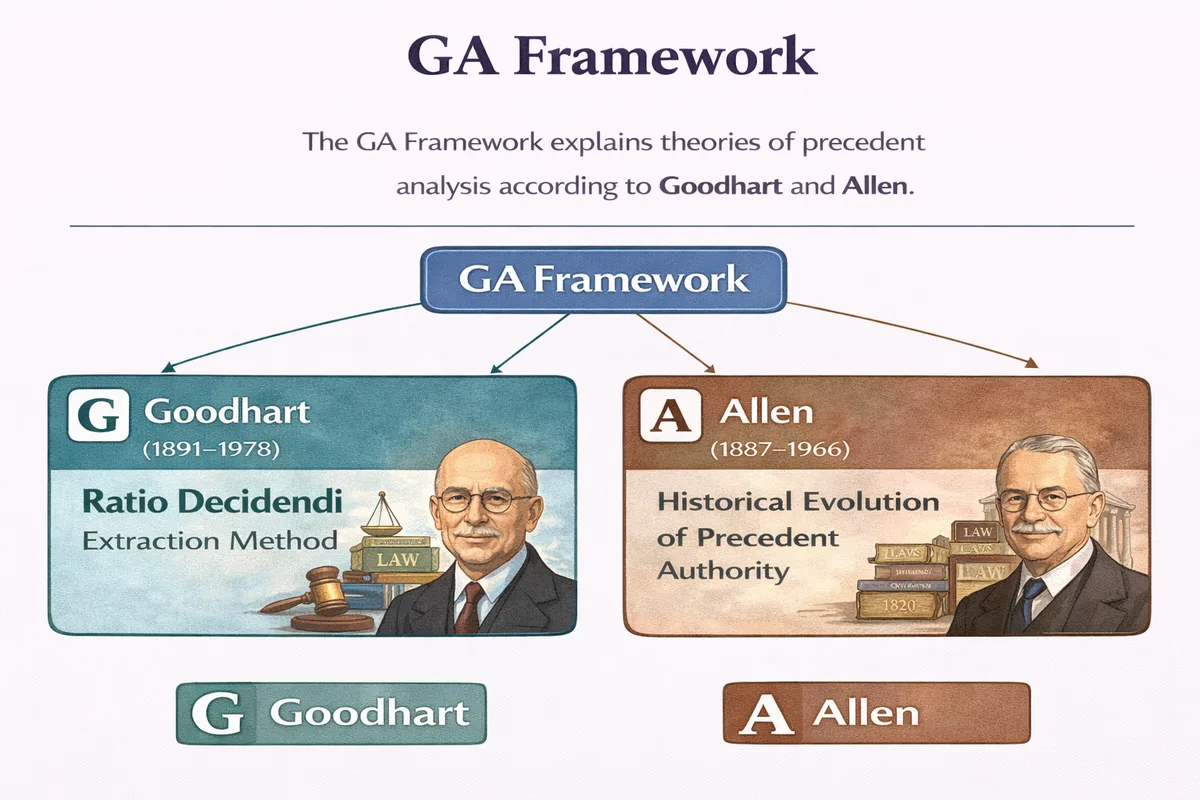
| Definition (Goodhart) | "The principle of a case is found by taking account of the facts treated as material by the judge, and the decision based on those facts." |
| Stare decisis | "Let the decision stand" follow earlier decisions of equal or higher courts |
| Art.141 | "The law declared by the Supreme Court shall be binding on all courts within India" |
| Art.144 | All civil and judicial authorities shall act in aid of the Supreme Court |
| Art.226/227 | High Court decisions bind subordinate courts within that state |
| Salmond's view | Precedent is a legal source creates law, not merely discovers it |
| Declaratory theory | Precedent merely DECLARES pre-existing law (Blackstone) judges find, not make, law |
Elements of a Precedent
| Element | Definition | Binding? |
|---|---|---|
| Ratio decidendi | The legal principle/reason that is NECESSARY to the decision; the rule without which the case would have been decided differently | YES this is the binding part |
| Obiter dictum | A statement made "by the way" not necessary to the decision; remarks on hypothetical situations or collateral points | NO persuasive only, not binding |
| Facts | The material circumstances of the case | Context for ratio future case must have similar material facts |
| Decision | The actual order/judgment (allow/dismiss appeal) | Binds the parties; the ratio binds future courts |
Why: Distinguishing ratio from obiter is the MOST IMPORTANT skill in precedent law. Only the ratio binds. A judge who says "In my view, the law on a completely different topic should be X" is stating obiter no future court is bound to follow it. The ratio is identified by asking: "What legal principle was ESSENTIAL to reaching this decision on THESE facts?"
Kinds of Precedent
By Binding Effect
| Kind | Definition | Example |
|---|---|---|
| Authoritative | MUST be followed (creates legal obligation) | SC decision binding on all courts (Art.141) |
| Persuasive | MAY be considered but NOT binding | Foreign court decision; obiter of higher court; HC decision in another state |
By Creative Effect
| Kind | Definition | Example |
|---|---|---|
| Original | Creates a NEW rule (no prior authority on the point) | Vishaka v. State of Rajasthan (1997) created sexual harassment guidelines where no legislation existed |
| Declaratory | Applies/restates an EXISTING rule | Court applying well-settled principle of res judicata to new facts |
By Status
| Kind | Definition |
|---|---|
| Absolutely authoritative | Must be followed even if court considers it wrong (only way out: distinguish on facts) |
| Conditionally authoritative | Binding unless shown to be clearly erroneous court may refuse to follow in exceptional cases |
Doctrine of Stare Decisis
| Rule | Application in India |
|---|---|
| SC binds all courts | Art.141: "law declared by SC shall be binding on all courts" |
| SC binds itself? | Generally yes, but SC can OVERRULE its own prior decisions (larger bench overrules smaller) |
| HC binds lower courts in state | Full Bench > Division Bench > Single Judge |
| HC of one state binds another? | NO only persuasive (each HC is coordinate court) |
| District courts bound by | HC of that state + SC |
When Stare Decisis Does NOT Apply
| Situation | Rule |
|---|---|
| Distinguishing | Later court holds the material facts are different prior precedent doesn't apply |
| Overruling | Higher court (or same court sitting as larger bench) declares the prior decision WRONG it ceases to be law |
| Per incuriam | Prior decision was made "in ignorance of" a relevant statute or binding precedent can be disregarded |
| Sub silentio | Point was not argued or considered in the prior case not truly "decided" |
| Obiter | Only the ratio binds; obiter can be disregarded |
| Obsolete | In very rare cases, court may decline to follow a very old decision that no longer reflects social conditions |
Merits and Demerits of Precedent
| Merits | Demerits |
|---|---|
| Certainty people can predict legal outcomes | Rigidity bad precedent persists until overruled |
| Equality like cases treated alike | Volume thousands of precedents make law complex |
| Flexibility develops incrementally as new situations arise | Retrospective new ratio applies to past conduct (parties couldn't have known) |
| Practical wisdom based on real disputes, not hypothetical situations | Illogical distinctions courts sometimes distinguish on trivial facts to avoid bad precedent |
| Fills legislative gaps where statute is silent, precedent governs | Undemocratic unelected judges make law |
| Detailed specific guidance for specific situations | Uncertain identifying the ratio in complex cases is often debatable |
Illustrations
-
Ratio vs obiter (the critical distinction): In Kesavananda Bharati (1973), the RATIO is: "Parliament's power to amend the Constitution under Art.368 does not include the power to destroy or abridge the basic structure of the Constitution." THIS binds every future court must follow. But if a judge in Kesavananda added: "In my opinion, the Right to Property should be restored as a fundamental right" that's OBITER (not necessary to the basic structure question). No court is bound by it. Lawyers who cite obiter as if it were ratio lose credibility.
-
Stare decisis serving equality: In Navtej Singh Johar (2018), the SC decriminalised homosexuality (reading down S.377). After this precedent, if a trial court in district X convicts a person under S.377 for consensual homosexual conduct, the High Court MUST overturn it Art.141 makes SC law binding. Without stare decisis: each district judge could reach different conclusions. With it: the law is UNIFORM across India. Whether you're in Delhi or a remote village, S.377 no longer criminalises consensual conduct. Stare decisis ensures the Constitution means the SAME thing everywhere.
-
Distinguishing (escaping a binding precedent without overruling): SC holds in Case A: "Government employees on probation can be terminated without hearing." Later, Case B comes: a government employee on probation is terminated specifically because she filed a corruption complaint against her superior. Can the court follow Case A? The court DISTINGUISHES: "Case A involved routine probation termination. Case B involves PUNITIVE termination (retaliation for whistleblowing). The material facts are different Art.21 due process applies here." The court doesn't overrule Case A it simply says: "Case A's ratio doesn't apply to THESE different facts."
-
Overruling (correcting bad precedent): In ADM Jabalpur v. Shivakant Shukla (1976), a 4:1 majority held that during Emergency, citizens cannot approach courts for habeas corpus (right to life suspended). For 40+ years, this was technically "law." In KS Puttaswamy v. Union of India (2017) (Right to Privacy), a 9-judge bench OVERRULED ADM Jabalpur: "The majority opinion in ADM Jabalpur is not good law. Even during Emergency, Art.21 cannot be suspended." The larger bench (9 > 4) corrected the error. Overruling is how the legal system self-corrects but only the SAME court (SC) or a LARGER bench can overrule.
Recall Check
- What is the doctrine of stare decisis and what is its constitutional basis in India?
- Distinguish ratio decidendi from obiter dictum.
- When can a court refuse to follow a binding precedent?
Distinctions
| Aspect | Ratio Decidendi | Obiter Dictum |
|---|---|---|
| Meaning | The legal principle necessary to the decision | Statement made by the way; not essential to decision |
| Binding? | Yes future courts MUST follow | No only persuasive |
| How to identify | Ask: "Without this principle, would the case be decided differently?" If yes = ratio | Hypothetical observations, discussions of law not relevant to the issue |
| Example | "Basic structure cannot be amended" (Kesavananda) | "Perhaps Art.31C should be reconsidered" (side remark) |
| Aspect | Authoritative Precedent | Persuasive Precedent |
|---|---|---|
| Binding? | Must be followed | May be considered; not binding |
| Source | Higher court in same hierarchy | Foreign court, HC of other state, obiter, dissent |
| Consequence of ignoring | Error of law; reversed on appeal | No error; court exercises discretion |
| Example | SC binding on all courts (Art.141) | English HC decision cited in Indian court |
| Aspect | Precedent | Legislation |
|---|---|---|
| Maker | Courts (through adjudication) | Legislature (through enactment) |
| Method | Case-by-case; arises from real disputes | Comprehensive; anticipates future situations |
| Temporal effect | Usually retrospective (declares what law was) | Usually prospective (applies to future) |
| Repeal | Overruled by larger bench or higher court | Repealed by later legislation |
| Coverage | Specific (one legal point per case) | General (entire subject covered) |
| Democratic basis | Unelected judges | Elected representatives |
Flashcards
What is precedent?
A judicial decision that contains a principle (ratio decidendi) serving as authority for deciding later cases with similar facts or legal issues.
What is stare decisis?
"Stand by what has been decided" courts must follow earlier decisions of higher courts (or their own prior decisions) to ensure consistency and predictability.
What is ratio decidendi?
The legal principle that is NECESSARY to the court's decision the binding element of a precedent that future courts must follow.
What is obiter dictum?
A statement made "by the way" in a judgment not essential to the decision. Persuasive only, not binding.
What is Art.141?
"The law declared by the Supreme Court shall be binding on all courts within the territory of India" constitutional basis of stare decisis in India.
When can a court escape a binding precedent?
(1) Distinguishing (different material facts), (2) Overruling (larger/higher bench declares it wrong), (3) Per incuriam (decided in ignorance of relevant law), (4) Sub silentio (point not argued or considered).
What is an "original" precedent?
A judicial decision that creates a NEW rule where no prior authority existed fills a gap in law. Example: Vishaka creating sexual harassment guidelines before legislation.
Exam Scenario
"Judges do not make law; they merely declare it." Critically examine the declaratory theory of precedent.
Declaratory theory (Blackstone): Judges do not CREATE law. They merely DISCOVER and DECLARE pre-existing law. Law has always existed in principle judges find it by applying reason to custom, statute, and prior decisions. If a court overrules a prior decision, the overruled decision was never really "law" the court was simply WRONG earlier.
Support for declaratory theory: (1) Maintains the separation of powers if judges MAKE law, they encroach on legislature's function. (2) Explains retrospective effect if judges merely declare what law always was, it makes sense that the declaration applies backward. (3) Judicial modesty prevents judges from claiming legislative authority.
Against the declaratory theory (realist critique):
(1) Original precedents create new law: In Vishaka v. State of Rajasthan (1997), the SC created sexual harassment guidelines where NO prior law, statute, or custom existed. No one can seriously claim the court merely "discovered" pre-existing law on workplace sexual harassment. It MADE law to fill a gap.
(2) Overruling disproves the theory: In Navtej Singh Johar (2018), the SC overruled Suresh Kumar Koushal (2013) on S.377. If judges merely "declare" pre-existing law, then the law on homosexuality was ALWAYS one thing but two benches reached opposite conclusions 5 years apart. The "pre-existing law" did not change; the JUDGES changed their minds. This is law-MAKING, not law-finding.
(3) Social context shapes decisions: ADM Jabalpur (1976) was decided during Emergency (fear of Executive). KS Puttaswamy (2017) was decided in a rights-expansive era. Same constitutional text (Art.21), radically different "declarations." What changed was not the "pre-existing law" but judicial ideology and social context.
(4) Austin/Salmond reject: Austin: judges are delegates of the sovereign what they decide IS law (tacit command of sovereign). Salmond: precedent is a LEGAL SOURCE it creates law, not merely discovers it. Gray: "The law is what the judges declare it to be; judge-made law is real law."
Conclusion: The declaratory theory is a FICTION useful for legitimacy (judges don't want to be seen as competing with Parliament) but descriptively inaccurate. In reality, judges CREATE law through original precedents, expand law through interpretation, and change law through overruling. The honest position (Hart, Salmond): judges MAKE law in the INTERSTICES (gaps) left by legislation they don't have unlimited legislative power, but within the space of legal indeterminacy, judicial decisions are genuinely creative acts that produce new binding rules.