Custom is a habitual course of conduct observed uniformly and voluntarily by a community for such a long time that it acquires the force of law. It is the OLDEST source of law before legislatures or courts existed, human communities regulated themselves through custom. In modern law, custom remains relevant where statute is silent.
Legal Framework
| Element | Content |
|---|---|
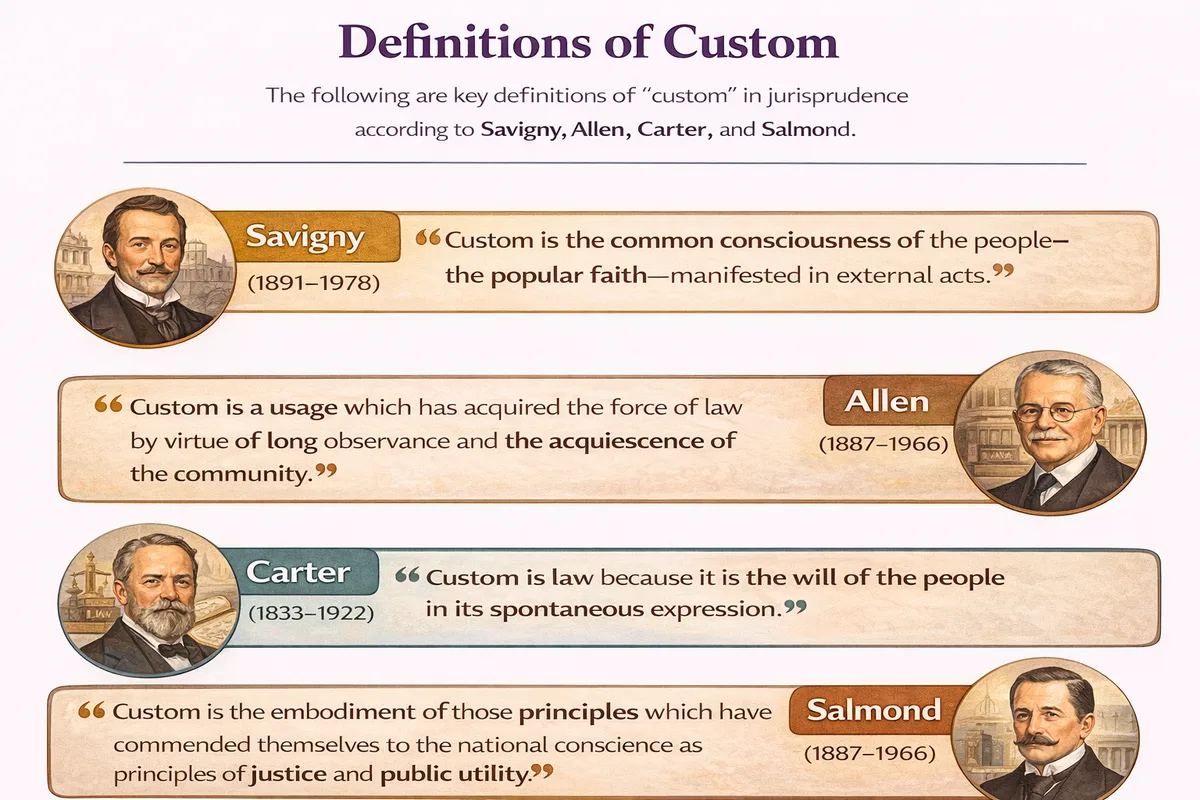
| Definition (Salmond) | "Custom is the embodiment of those principles which have commended themselves to the national conscience as principles of justice and public utility" |
| Definition (Austin) | Custom is not law until the sovereign (through courts or legislation) gives it legal recognition |
| Indian recognition | S.8 CPC: court may accept custom as law if proved; Hindu Marriage Act S.7: ceremonies per custom |
| Burden of proof | Person claiming custom must prove it (S.8 CPC) |
| Contrast | Savigny: custom IS law (Volksgeist). Austin: custom becomes law only through state recognition |
Kinds of Custom
Legal Customs (Binding)
| Kind | Scope | Example |
|---|---|---|
| General custom | Prevails throughout a territory/community | Hindu customs on marriage ceremonies applying to all Hindus |
| Local custom | Prevails in a specific locality only | Custom of a particular village regarding water rights |
Conventional Customs (Contractual)
| Kind | Nature | Example |
|---|---|---|
| Trade usage | Practice in a particular trade binding on parties | Banking custom that cheques are valid for 6 months (before RBI changed to 3) |
| Contractual custom | Implied terms from customary practice | Custom in Bombay cotton market regarding delivery timelines |
Why: The distinction matters for PROOF and APPLICATION. Legal customs bind ALL persons in the relevant community (even those unaware of them). Conventional customs bind only parties to a transaction in that trade/locality (like implied contract terms).
Custom vs. Prescription
| Aspect | Custom | Prescription |
|---|---|---|
| Creates | A general right for a CLASS of persons | A specific right for a PARTICULAR person |
| Example | "All villagers have right to use the village pond" (custom) | "A has right of way over B's land by using it for 20 years" (prescription specific to A) |
| Scope | General (applies to community) | Individual (applies to one person/property) |
| Period | Immemorial (no one remembers when it began) | Statutory (20 years for easement under Indian Easements Act) |
| Legal basis | Customary law | Limitation/Easements Act (statutory) |
Requisites of a Valid Custom
For a custom to be recognised as LAW, it must satisfy ALL of these requirements:
| Requisite | Meaning | Test |
|---|---|---|
| Antiquity (immemorial) | Must have existed from time beyond memory | No one alive remembers when it began; "since time immemorial" |
| Continuity | Must have been observed without interruption | Continuous practice, not sporadic observance |
| Peaceable enjoyment | Must have been observed without dispute or contest | Acquiesced in by the community; not exercised by force |
| Obligatory force | Must have been observed as a binding rule, not a mere practice | Community feels BOUND (not optional) |
| Certainty | Must be clear and definite in its content | Ambiguous or vague custom fails |
| Consistency | Must not contradict another established custom | Inconsistent customs cancel each other |
| Reasonableness | Must not be unreasonable or absurd | Custom must serve some rational purpose |
| Conformity to statute | Must not contradict enacted law | Statute overrides custom (legislative supremacy) |
| Not immoral | Must not be opposed to public policy or morality | Custom of sati, child marriage invalid even if ancient |
Why: These requisites prevent arbitrary claims. Without them, anyone could invent a "custom" yesterday and claim legal force. The tests ensure only genuinely established, socially accepted, and legally compatible practices become law.
Theories on Custom as Source of Law
| Theory | Proponent | Custom Becomes Law When... |
|---|---|---|
| Historical theory | Savigny | Custom IS law from the moment it arises from Volksgeist no state recognition needed |
| Analytical theory | Austin | Sovereign (through courts) recognises it. Before recognition, it is merely "positive morality" |
| Implied command theory | Austin | Court recognition = tacit command of sovereign (sovereign permits courts to enforce custom) |
| Democratic theory | Carter | Custom represents the actual consensus of the community. It is more democratic than legislation because it evolves from the practice of ALL members, not just elected representatives |
| Historical-sociological | Allen | Custom grows through historical practice and becomes law when society accepts it as binding. Not sovereign command (Austin) and not merely Volksgeist (Savigny) but observable social acceptance |
Memory Aid (SAC): Three perspectives on WHY custom is law: S = Savigny (Volksgeist: organic consciousness of the people) A = Austin (State recognition: not law until sovereign adopts) C = Carter (Community consensus: democratic expression of the people's will) | Approval theory | Holland | Courts APPROVE custom, thereby transforming social practice into legal rule |
Illustrations
-
Custom binding where statute is silent (Indian practice): In parts of Punjab, there is a custom that collateral male relatives (brothers, uncles) inherit property before daughters. The Hindu Succession Act, 1956 gave daughters equal rights. But for AGRICULTURAL LAND in Punjab, the state amendment excluded agricultural land from the Act's application (now changed post-2005). During the exclusion period, courts applied CUSTOM to agricultural land because statute was silent on it. This shows custom's role: it fills gaps WHERE statute doesn't reach. Once statute covers the field (post-2005 amendment), custom gives way.
-
Requisites applied (custom failing the reasonableness test): A community claims a "custom" that a widow must jump into her deceased husband's funeral pyre (sati). Is this legally valid? Check requisites: Antiquity? Yes (ancient practice). Continuity? Arguably yes in some communities. Obligatory force? Community treated it as binding. But: REASONABLENESS? NO it results in death/murder. MORALITY? NO violates right to life (Art.21). CONFORMITY TO STATUTE? NO Sati Prevention Act, 1987 criminalises it. Custom FAILS on multiple grounds. Merely being ancient does not make a practice "law."
-
Custom vs prescription (the difference): Scenario A (Custom): "All fishermen of Coastal Village X have a right to dry nets on the foreshore." This is a CUSTOM a right for an entire CLASS (all fishermen in that village). Any fisherman born into that community can exercise this right. It doesn't depend on how long any individual fisherman has used the shore.
Scenario B (Prescription): "Farmer A has been using a path across Farmer B's field for 25 years without B's objection." This is a PRESCRIPTIVE right (easement by prescription) specific to A personally. A's son cannot claim the same right unless he independently satisfies the 20-year requirement. It's a right of ONE PERSON, acquired by long user, not a community-wide custom.
-
Trade usage as implied contract term: In the Bombay cotton trade, there is a centuries-old custom that delivery must occur within 14 days of contract unless otherwise specified. A and B make a cotton contract without mentioning delivery time. A delivers on Day 20. B rejects: "Trade custom says 14 days you're late." A argues: "We didn't agree to 14 days." Court holds: trade custom IMPLIES a 14-day term into every cotton contract in Bombay unless expressly excluded. This is conventional custom it doesn't bind a stranger to the cotton trade, but it binds EVERYONE dealing in Bombay cotton.
Recall Check
- What are the requisites for a valid custom?
- Distinguish legal custom from conventional custom.
- How does Austin's view of custom differ from Savigny's?
Distinctions
| Aspect | Custom | Legislation |
|---|---|---|
| Origin | Evolves unconsciously from social practice | Deliberately made by legislature |
| Form | Unwritten (proved by evidence) | Written (published in Gazette) |
| Proof | Party asserting must prove (S.8 CPC) | Court takes judicial notice (no proof needed) |
| Flexibility | Evolves gradually | Changes only by amendment |
| Scope | Usually local/community-specific | Usually national/state-wide |
| Override | Statute overrides custom | Legislature can abolish custom expressly |
| Democratic basis | Community consensus over time | Elected representatives |
| Aspect | Legal Custom | Conventional Custom |
|---|---|---|
| Binding on | Entire community (even those unaware) | Only parties to transactions in that trade/locality |
| Source of authority | State recognition (courts applying it) | Implied agreement of parties |
| Analogy | Like statute (general application) | Like contract term (specific application) |
| Example | Hindu marriage ceremony custom | Banking custom on cheque clearing time |
| Proof | Established as community practice | Established as trade usage |
Flashcards
What is custom in jurisprudence?
A habitual course of conduct observed uniformly and voluntarily by a community for so long that it acquires the force of law.
What are the requisites of a valid custom?
Antiquity (immemorial), continuity, peaceable enjoyment, obligatory force, certainty, consistency, reasonableness, conformity to statute, not immoral.
What is the difference between custom and prescription?
Custom creates a general right for a CLASS (all villagers can use pond). Prescription creates a specific right for a PARTICULAR person (A has easement over B's land by 20 years' use).
How does Austin view custom?
Custom is NOT law until the sovereign (through courts) recognises it. Before recognition, it is "positive morality" a social practice without legal force.
How does Savigny view custom?
Custom IS law from the moment it arises from the Volksgeist (people's consciousness). No state recognition is needed law grows organically from custom.
Can custom override statute?
No. Statute prevails over custom (legislative supremacy). A custom inconsistent with enacted law is invalid regardless of its antiquity.
What is a "conventional custom"?
A trade or market usage that operates as an implied contractual term binding on parties dealing in that trade, not on the general public. Example: Bombay cotton market delivery timelines.
Exam Scenario
"Custom is the oldest source of law but cannot override legislation." Discuss the role and limitations of custom as a source of law in India.
Custom as source: (1) OLDEST source before legislatures or courts existed, communities governed themselves entirely by custom (tribal law, village panchayat norms, trade guilds). (2) S.8 CPC recognises custom: "where parties are governed by custom, court shall enforce that custom if proved." (3) Hindu Marriage Act S.7: marriage solemnised per customary ceremonies is valid (rites may be performed per custom even though Act exists). (4) Custom fills gaps: where statute is silent, courts resort to established custom (agricultural land rights, water sharing, community grazing rights).
Requisites for validity: Custom must satisfy antiquity, continuity, reasonableness, certainty, obligatory force, consistency, and conformity to statute and morality. These requirements ensure only GENUINE and ACCEPTABLE customs get legal recognition not invented claims or oppressive practices.
Limitation cannot override statute: (1) LEGISLATIVE SUPREMACY: Art.13(1) pre-existing customs that violate fundamental rights are void. (2) SPECIFIC OVERRIDE: Hindu Succession Act overrides custom that denied daughters inheritance. Sati Prevention Act overrides custom of widow immolation. Special Marriage Act overrides customary restrictions on inter-caste marriage. (3) HIERARCHY: Constitution > Statute > Precedent > Custom. Custom occupies the LOWEST tier of binding legal sources. (4) Art.14 EQUALITY: Any custom that discriminates (based on caste, gender) fails the equality test even without specific statutory override.
Modern relevance: Custom is declining as a source because: (a) comprehensive legislation now covers most fields (little room for gap-filling), (b) fundamental rights strike down discriminatory customs, (c) urbanisation dissolves community-specific practices. BUT: custom remains vital in tribal areas (Scheduled Tribes: customs recognised by Fifth/Sixth Schedule), personal law (marriage ceremonies), and agricultural communities (water rights, grazing).
Conclusion: Custom's role is RESIDUAL in modern India it operates where statute is silent and fundamental rights are not violated. It cannot OVERRIDE legislation (hierarchy principle) but fills gaps within the legislative framework. Savigny's vision of custom as primary source has been overtaken by legislative supremacy, but custom's contribution to law's historical content remains undeniable.